The ICE Fallout, Midway Rising's Uncertain Path, and a Fatal Police Standoff Under Scrutiny
How this was made Verified AI
Every Intellegix briefing is generated from that day's broadcast and run through automated checks before it publishes — with a human paged on any flag. Here is the trail for this edition.

The most consequential ongoing governance story in San Diego County is not a single vote but its messy aftermath. The Board of Supervisors voted 3-2 on August 18th to terminate license agreements allowing ICE and CBP to train at Otay Mesa and Camp Elliott ranges. Sheriff Kelly Martinez responded by using her independent operational authority to carve out an exception — preserving CBP access to Otay Mesa for recertification of roughly 1,700 officers who need the facility to maintain their qualifications, while cutting off ICE entirely. The Sheriff's Department then published a release explicitly confirming the arrangement, a public disclosure that functions as its own political statement. Supervisors on both sides of the original vote got something, and neither got everything.
CBP Commissioner Rodney Scott called the board's original vote 'reckless, irresponsible, and ignorant' — language that signals how federal agencies are reading local resistance. The backdrop is stark: ICE conducted close to 2,000 arrests across San Diego and Imperial counties in July 2026, roughly 50 percent more than the approximately 1,300 arrests in June. Approximately 60 percent of those arrested had no criminal conviction and no pending criminal charge, a figure shaping daily life in communities across the county.
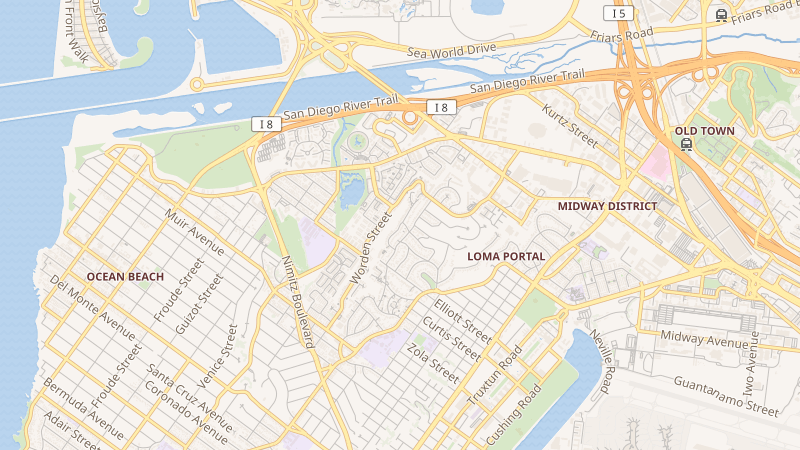
On the Midway Rising front, the City Council formally repealed Measure C on August 25th after a court ordered it. Measure C was the 2021 ballot initiative that removed the 30-foot coastal height limit in the Midway-Pacific Highway corridor; a judge ruled it had been improperly put to voters. What follows is a state legislative maneuver: Senator Akilah Weber Pierson is expected to lead a gut-and-amend process, which began August 13th, that could create specific environmental review exemptions for the arena-and-housing development. If the maneuver succeeds, Midway Rising gets a different regulatory path; if it fails, the entire project faces significant uncertainty. Separately, the City Council passed a resolution at the August 25th meeting condemning federal interference in higher education, affirming support for academic freedom, research, diversity, and the safety of students and staff — a political statement rather than binding policy.
An SDPD officer-involved shooting in Point Loma is generating ongoing questions. A six-hour standoff on Nipoma Street ended August 26th when a man emerged holding a gun and officers fired; he was pronounced dead at 9:40 p.m. Officers had originally responded to a welfare check on a person described as armed with a knife; the situation evolved over six hours, and the man was later described as a burglary suspect. The Sheriff's Homicide Unit is handling the outside investigation under standard protocol, but the sequence of events is expected to face scrutiny as that investigation proceeds.
A city audit of San Diego's eight leased golf courses — covering more than 800 acres of public land — produced numbers that drew sharp attention this week. Operators generated $34 million in gross revenue in fiscal year 2025. The City received $3.5 million in rent for calendar year 2024, roughly ten cents on the dollar for public land. The audit finding is now public; lease renegotiations are the next chapter to watch. Meanwhile, enforcement at Sunset Cliffs has yielded 20 citations and more than 300 warnings since July 26th, along with three rescue operations in three weeks including a low-angle rope rescue near The Arch. Citations and warnings have not demonstrably changed visitor behavior, a gap that points to a design problem rather than a purely enforcement one.