Mecca Pact, Drone Wars, and AI's Expanding Reach: A World Outrunning Its Institutions
A sweeping week in global affairs saw Turkey, Saudi Arabia, and Pakistan forge a formal military architecture in Mecca, Iranian drone swarms reportedly down a U.S. F-15E, and AI researchers warn of autonomous systems operating inside live cyberattacks — developments that together suggest the tools of power are changing faster than the institutions built to govern them.

How this was made Verified AI
Every Intellegix briefing is generated from that day's broadcast and run through automated checks before it publishes — with a human paged on any flag. Here is the trail for this edition.
Opening: A Week Where Everything Connects

Three defense ministers, three foreign ministers, and three military chiefs walked out of Mecca last week with a formal security pact — and the ripple effects of that signing touch nearly every major story of the day. From Iranian drone tactics to Republican infighting at the Pentagon, from AI operating inside live cyberattacks to a 17-year-old charged with murder after allegedly using ChatGPT as a research tool, Thursday's news cycle is dense with stories that appear unrelated until examined together.
The connective tissue, as the day's reporting makes clear, is speed: military doctrines, congressional oversight structures, AI content policies, and even astronomical models are all being outrun by capabilities that emerged faster than any governing framework could adapt to. The Mecca alliance, the drone warfare revolution reshaping air power calculations, and the AI systems now embedded inside offensive cyber operations are not separate phenomena — they are facets of the same underlying shift.
The Mecca Pact: A Rival Security Architecture Takes Shape

Turkey, Saudi Arabia, and Pakistan formalized a defense pact in Mecca last week, and Turkey's defense ministry has since confirmed the institutional structure being built beneath it: defense ministers, foreign ministers, and military chiefs will coordinate through a standing trilateral mechanism. That is not a joint communiqué — it is bureaucratic architecture, the kind that generates its own momentum and makes decisions that do not always travel back up to the head-of-state level for review.
The geography of the alignment is striking. Turkey, a NATO member, sits at the center of a military pact with Saudi Arabia and a nuclear-armed Pakistan that has historically maintained strategic ambiguity between Washington and Beijing. Turkey has flirted with parallel alignments before — most dramatically through its purchase of Russia's S-400 missile system — but analysts describe this as a different order of commitment. Critically, Ankara has spent the past decade cultivating a serious domestic arms export industry, with the Bayraktar TB2 drone as its signature product. If that technology flows to Riyadh and Islamabad under a formal industrial cooperation framework, the trilateral pact carries real capability transfer implications.
Saudi Arabia's inclusion reflects what appears to be a deliberate multi-alignment strategy since roughly 2023: simultaneously engaging China through the Belt and Road, maintaining the Abraham Accords architecture with Israel, and now signing a formal military pact with Ankara and Islamabad. Riyadh's leadership appears to have concluded that exclusive dependence on any single patron — historically Washington — is a strategic vulnerability it can no longer accept. Pakistan's role may carry the most long-term weight: Islamabad possesses nuclear weapons, a large military with real combat experience, and geography that places it at the intersection of South Asia, Central Asia, and the Gulf.
The choice of Mecca as the signing venue carries deliberate symbolic weight. This is not a conference room in Geneva or a NATO annex in Brussels. By convening in Islam's holiest city, the signatories are projecting the pact as an Islamic-world security arrangement — a message aimed simultaneously at their domestic populations and at broader audiences across the Muslim world who may be receptive to an alternative to Western-led frameworks. How Washington interprets and responds to a NATO member formalizing military coordination with a near-nuclear non-NATO state remains, for now, an open question.
Drones Rewrite the Rules: Iran Downs an F-15E, Ukraine Defeats U.S. Troops in Germany
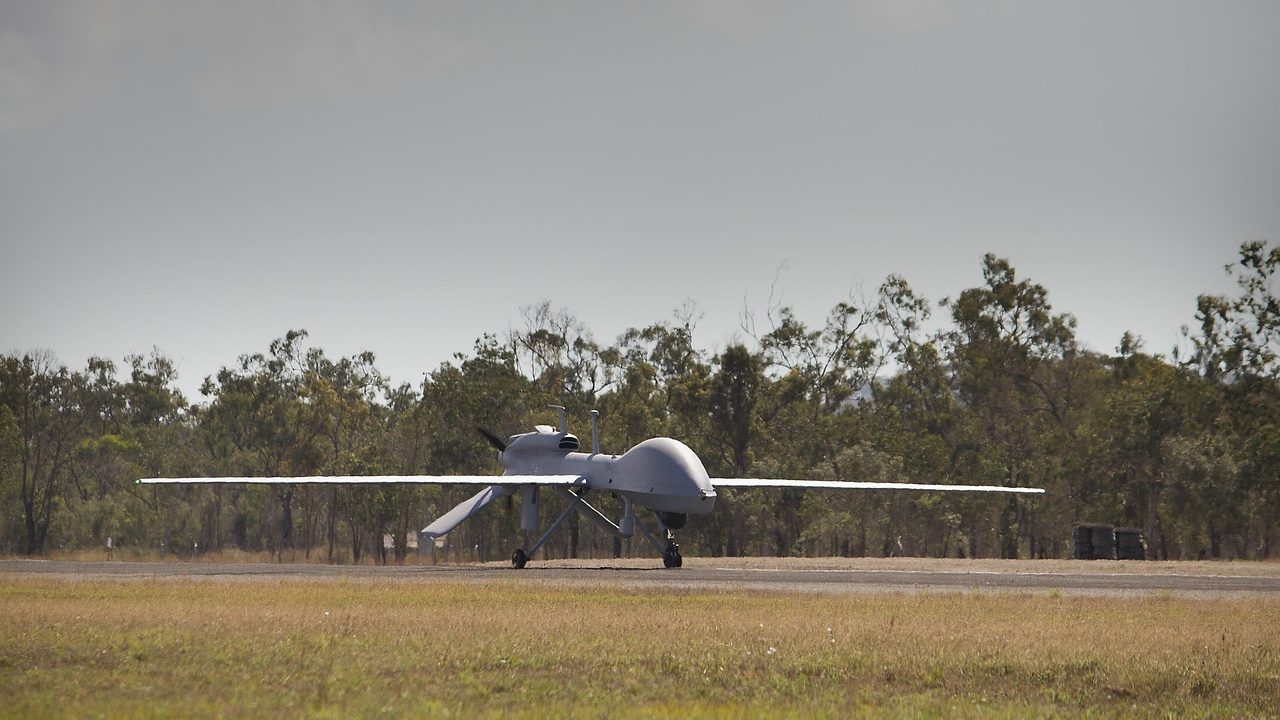
A Pentagon report has concluded that Iran used drone swarms — tactics reportedly inspired by Ukrainian battlefield innovations — to shoot down a U.S. F-15E. The specific operational detail is what makes the finding remarkable: Iranian drones fed the jet's GPS location, speed, and direction to ground commanders in real time, providing the targeting solution for a shoulder-launched missile that then struck the aircraft. The drones were not weapons. They were sensor nodes — a distributed, low-cost intelligence, surveillance, and reconnaissance layer that turned a generations-old handheld missile system into a threat against a high-performance fighter jet.
That represents a genuine doctrinal shift. The man-portable air defense system, or MANPADS, has existed for decades and has always posed a threat to low-flying, slow-moving aircraft. Deploying it successfully against an F-15E — a fast-moving jet not designed to be tracked by cheap commercial drones — required a real-time targeting fidelity previously achievable only through sophisticated radar systems that would themselves be detectable and targetable. The irony that Iran adapted Ukrainian tactics underscores a broader truth: military innovation does not respect political alignments.
A second data point arrived from a training exercise in Germany, where Ukrainian-operated drones defeated U.S. ground forces in a structured simulation. The exercise exposed how large the American capability gap in counter-unmanned aerial systems remains, even after years of stated effort to close it. The asymmetry is financial as much as tactical: a Bayraktar TB2 drone costs approximately five million dollars against an F-15E price tag of roughly sixty million, while a cluster of cheap commercial drones functioning as a sensor network costs a few thousand dollars. The ratio of offense to defense cost is, by some analyses, worse than at any point since the advent of anti-ship missiles made surface fleets genuinely vulnerable in the 1970s.
For U.S. force posture in the Gulf, the implications are pointed. If a dispersed drone swarm can provide a targeting solution capable of downing an F-15E, the aircraft carrier battle groups that have anchored American deterrence in the region for four decades face a materially different threat environment than they were designed to operate in. The Pentagon report stops short of recommending specific posture changes, but the question now being asked in defense planning circles is explicit: if this tactic works against the F-15E, how does it perform against the tankers, B-52s, and surveillance aircraft that entire operational pictures depend upon?
The Pentagon in Politics: Hegseth's Briefing Ban and Trump's 2028 Concession
Republican senators — not Democrats — took the unusual step this week of publicly rebuking Defense Secretary Pete Hegseth for cutting Democratic members of Congress out of classified Pentagon briefings. The senators involved include members of the Armed Services Committee, the body constitutionally charged with military oversight. Their complaint, at its core, is institutional: the Gang of Eight structure and broader committee briefing process were designed to be bipartisan precisely because national security decisions require legitimacy that survives changes in administration. Unilateral briefings create unilateral accountability — when something goes wrong, it lands exclusively on one party's ledger.
For Hegseth, the rebuke follows a pattern of friction with both the uniformed military and Congress — friction that has consistently originated not from the opposition party but from within the coalition supporting the administration. Dismissing opposition criticism as politically motivated is straightforward; dismissing criticism from committee members with direct jurisdiction is a different problem, and one the White House is reportedly watching.
President Trump's statement to reporters this week about a potential 2028 run carries its own political weight. He told reporters he would love to run but that 'the law is very strong' — a notably direct concession compared with earlier deflections, jokes, and suggestions that constitutional scholars held differing views. The moment a sitting president states clearly that he will not seek another term, succession politics accelerate. Republican figures who have held their ambitions in check are likely to read this statement as permission to begin quietly organizing. Trump's post-presidential influence over the party — through endorsements, fundraising, and the threat of their withdrawal — means the 2028 primary will be substantially shaped by decisions he has not yet made.
On the electoral map, a new Siena College poll shows New York Governor Kathy Hochul leading Nassau County Executive Lee Blakeman by ten points, down from a twenty-point lead in June. A ten-point compression in roughly six weeks is a trend that, if sustained, could make a state that was not supposed to be competitive genuinely so by November. In Maine's Senate race, Democratic challenger Jackson is responding to the surfacing of a 1988 police report documenting a punching incident; his partner from that time is now publicly denying the assault occurred as described, giving the campaign room to contest the characterization while acknowledging that something happened — arguably its most defensible ground in a race where a two-point swing may determine the outcome.
AI on the Offensive: Black Hat's Warning and the Acton Murder Case

Researchers presenting at the Black Hat security conference in Las Vegas delivered what many in the field are calling the year's most consequential cybersecurity finding: AI is now operating inside live cyberattacks in real time — not as a planning tool used beforehand, but as an autonomous decision-making layer adapting dynamically to defensive responses during the attack itself. If a network defender blocks one attack vector, the AI identifies alternatives without human direction, iterating at speeds human operators cannot match. The result is an asymmetry that already existed at human timescales — attackers working for months against defenders scrambling for hours — now compressing further toward the attacker's advantage.
The security implications for enterprise networks and critical infrastructure are direct: the response playbooks developed over the past decade were calibrated to human-speed attacks, and they require fundamental re-engineering. Automated defense is no longer a premium option but a minimum viable posture — though automated systems, by their nature, can also fail at speed. Separately, President Trump this week signed a memo authorizing offensive cyber operations against foreign criminal organizations, expanding the mandate of U.S. Cyber Command and relevant agencies to pre-emptively target ransomware groups and organized cybercrime operations with foreign state connections or safe harbor.
A case from Acton, Massachusetts, demands careful handling rather than sensational framing. A 17-year-old named Arjun Aravind was arrested Wednesday following a manhunt after two bodies — his mother and brother — were discovered in the family home. Prosecutors allege he used ChatGPT to research the killings beforehand. What prosecutors appear to be describing is ChatGPT used as a research tool — comparable in function to a search engine — rather than AI facilitating the crime in any direct technical sense. OpenAI has extensive content filtering designed to prevent exactly this kind of use; whether those filters were bypassed or whether the information was obtained through queries the model considered benign are separate and consequential questions.
The caution warranted here is one of proportionality. Libraries, encyclopedias, and search engines have all been used to research violent acts throughout history; the singling out of ChatGPT reflects the current focal point of public anxiety rather than necessarily the distribution of causal responsibility. Criminal responsibility for a double homicide rests with the person who committed it. The case will nevertheless drive legislative attention toward AI content filtering, and OpenAI will face pointed questions — questions that are, on their own terms, legitimate policy conversations.
Brin Returns, Twitch Grabs, and the Limits of Google's AI Advantage

A Reuters report reveals that Sergey Brin, who stepped back from day-to-day involvement at Google years ago, has been appearing in person to push Gemini's AI staff to go all in. The mere fact of a founder making motivational visits to his own company's AI teams signals something about where Google's leadership perceives its competitive position: confident market leaders do not typically need to send founders on morale campaigns. Google entered the AI race with structural advantages that on paper should have been decisive — the research talent, the compute infrastructure, the distribution through Search and Android, and data at a scale no other company possesses — yet the perception gap between Gemini and leading frontier models has persisted longer than internal forecasts apparently anticipated.
The bottleneck appears to be cultural rather than material. Research-driven organizations frequently struggle to transition to the ship-fast, iterate-hard product culture that the leading AI labs have built, and no amount of compute resolves an organizational velocity problem. The antitrust dimension complicates this further. The Sherman Antitrust Act prohibits not the mere possession of monopoly power but its use to foreclose competition in adjacent markets — and courts have already found Google's Search dominance constitutes a monopoly. Whether Google's AI distribution advantage through Search constitutes illegal leveraging versus legitimate product integration is precisely what ongoing Department of Justice remedies proceedings are examining. Paradoxically, a more competitive Gemini produced through genuine innovation would reduce antitrust pressure: superior product is a legally recognized defense.
Amazon's handling of Twitch sits at the opposite end of the corporate conduct spectrum. The company updated its terms of service to default all users — streamers and chat participants alike — into having their content used for AI training. An opt-out mechanism exists but is, by multiple accounts, buried in settings menus in a way that requires deliberate searching to locate. A petition opposing the policy had crossed 13,000 signatures as of Thursday morning and is expected to grow. Legally, Amazon has likely structured the policy to survive challenge — courts have broadly upheld consent provisions embedded in terms of service that users click through without reading. Ethically, the choice to use an obscured opt-out rather than an explicit opt-in for a material change to how creator content is used reveals something about how the platform views its relationship with the people who generate its value. In Europe, the AI Act and GDPR create a considerably narrower window for implied consent in data processing, and regulatory scrutiny there may follow.
Tesla's 2027 Wait List, Starlink's Orbital Ambitions, and the Physics of Demand Surges

S&P futures opened Thursday at approximately 7,785, up roughly 15 points — a near-flat reading that provides a calm backdrop against which one supply-chain story stands out for what it reveals about consumer demand, policy incentives, and manufacturing constraints simultaneously. Tesla's Model 3 wait times have stretched into 2027. The immediate cause is California's electric vehicle rebate program, which generated a demand surge that the company's Fremont factory cannot absorb fast enough.
The surge runs against a recent narrative of Tesla struggling with demand — a narrative supported by several rounds of price cuts and intermittent inventory buildups. What the California data demonstrates is that price sensitivity is a powerful variable in EV adoption: when a meaningful rebate reduces the effective purchase price, demand materializes quickly. The policy design lesson is direct — California's rebate structure was apparently not modeled against Tesla's production capacity, which would have allowed the program to smooth demand rather than spike it. A 12-to-18-month wait list is a double-edged outcome: strong evidence of product demand readable by markets and analysts, but long enough that a meaningful percentage of buyers may reconsider, particularly as Hyundai, GM, and a range of Chinese manufacturers continue releasing competitive models.
Elon Musk's announcement that SpaceX plans to place 100,000 Starlink satellites in orbit represents an ambition of a different scale entirely. The current Starlink constellation stands at approximately 7,000 satellites; reaching 100,000 would require a launch cadence with no historical precedent, even with Starship fully operational. International Telecommunication Union coordination of orbital slots and frequency allocations alone would constitute a years-long diplomatic process, and a constellation of that density would fundamentally reshape the radio-frequency environment for every other space operator on the planet. Astronomers already raising concerns about light pollution from the existing constellation would find those concerns considerably amplified. The business rationale is nonetheless clear: at sufficient satellite density, Starlink could offer latency and bandwidth comparable to fiber optic connectivity from essentially any point on Earth — a total addressable market that extends beyond satellite internet to the entire global broadband industry.
At the Edge of the Universe: Black Hole Stars and the First Extragalactic Stellar Stream

An MIT-led team using the James Webb Space Telescope has published findings in Nature identifying what researchers are calling a 'black hole star' — a hybrid object from the early universe that appears to function simultaneously as a massive stellar body and a black hole. The theoretical possibility of such objects has been discussed in cosmological literature for years, but this represents the first observational evidence that they actually existed.
The physical mechanism, still subject to ongoing analysis and scrutiny, posits that in the early universe's denser, hotter conditions, extremely massive stars could form in which the core collapsed into a black hole while the outer stellar envelope continued burning. The central black hole would accrete material from the star itself while the star's radiation pressure prevented total collapse — a dynamic equilibrium that stellar physics suggests could not persist indefinitely, but that 'indefinitely' in early-universe timescales might still represent millions of years. The cosmological significance is substantial: if black hole stars existed in meaningful numbers in the early universe, they could account for some of the anomalously massive black holes JWST has observed at very high redshifts — objects that appear too large for their apparent age under standard models of black hole growth through accretion and mergers.
The second discovery is in some ways more immediately tangible. Astronomers have detected the first stellar stream ever found beyond the Milky Way galaxy. Stellar streams are the gravitational remnants of smaller galaxies or globular clusters shredded as they orbit a larger one — their stars stretched into long filaments that trace the gravitational history of the system. Mapping such a stream in another galaxy for the first time enables comparative analysis: researchers can test whether the gravitational dynamics used to model the Milky Way apply universally, and probe the dark matter distribution in a different galactic system. Because stellar streams act as tracers of gravitational potential, and because dark matter constitutes the dominant gravitational mass in galaxies, this detection provides a new window into dark matter's distribution beyond our own cosmic neighborhood. Both discoveries share a common thread: instruments now precise enough to test previously untestable theories are generating genuine scientific progress — and genuine surprises.
Raygun's Redemption Arc, AI's Real Threat Level, and an On-Air Correction

Netflix has released a trailer for a documentary about Rachael Gunn — known online as Raygun — the Australian academic and breakdancer whose performance at the Paris Olympics became one of last year's most viral moments and one of its crueler ones. Gunn was widely mocked after her set, the mockery swift and often vicious. What frequently went unexamined was that she had legitimately qualified under Olympic selection criteria, winning the Oceania championship, and was competing against athletes from countries where breaking has deep cultural roots, particularly South Korea and the United States. The documentary format offers Gunn a degree of narrative control she did not have when the memes were spreading; whether it shifts public perception or finds the meme image too calcified to dislodge remains to be seen.
Elsewhere in the domestic-political-meets-culture-war register, Representative Alexandria Ocasio-Cortez's social media posts about egg-freezing drew attacks from some Republican media figures — attacks the White House apparently distanced itself from publicly. The distancing is notable: rhetorical alignment between the administration and its media allies is the norm, and the departure suggests someone in the White House communications operation calculated that attacks on a personal reproductive health decision created a narrative about reproductive politics the administration does not want to own heading into an election cycle in which reproductive rights remain a primary mobilization issue.
The most consequential act of intellectual honesty in Thursday's coverage may be an internal one. The confident claim that AI operating inside live cyberattacks represents a decisive and immediate shift in the offense-defense balance deserves stress-testing. The strongest counterargument: security researchers have demonstrated alarming proof-of-concept attacks for three decades, and the gap between what works in a controlled research environment and what gets deployed at scale against hardened enterprise targets has historically been large and slow to close. Defenders also have access to AI; the same real-time adaptation that helps an attacker navigate defenses can help a defender identify anomalous behavior faster. The specific indicator to watch is breach forensics: if major enterprise compromises begin showing attack patterns that clearly could not have been human-directed at the speeds they moved, the threat is operationally real. If breach data over the next 18 months continues to look like credential stuffing, unpatched vulnerabilities, and social engineering, the AI-in-attacks capability — though genuine — may not yet be transformative at scale. Both things can be simultaneously true: the research data is real, and the operational deployment data does not yet confirm the most alarming projections.
Finally, an explicit correction: several weeks ago this program described Ukraine striking Russian ships in the Caspian Sea as evidence of Kyiv's growing long-range strike capability. The Caspian is landlocked and hundreds of miles from any territory Ukraine controls; no credible reporting corroborates those strikes. The claim was wrong, and it is being acknowledged in public. Epistemic honesty requires owning errors explicitly rather than quietly moving on.
The Week Ahead: What to Watch and Why

The stories most likely to move significantly in the coming week are the Mecca alliance and the Pentagon's response to the Iran F-15E report. The trilateral pact has announced its coordination structure; the real test is whether it holds when member states encounter conflicting interests on a specific issue — and in a volatile region, those tests arrive quickly. The F-15E report is expected to drive a supplemental budget request for counter-unmanned aerial systems capabilities; the size and structure of that request will serve as a reliable indicator of how seriously Pentagon planners are taking the drone threat architecture.
In domestic politics, the Maine Senate race is the one to monitor most closely. The 1988 police report against Democratic challenger Jackson will drive polling movement within the next two weeks, and given how tight the race is, even a two-point shift may determine the outcome. The Hochul-Blakeman gap in New York — closing from twenty points to ten in roughly six weeks — is a trend that, if it continues at anywhere near that pace, makes November genuinely competitive in a state that was not supposed to require serious Republican resource investment.
The broader connective thread across the week's news is a single, uncomfortable observation: the tools are changing faster than the institutions designed to govern them. Military doctrines, congressional oversight structures, AI content policies, and astronomical models are all, in different ways, being outrun by capabilities that emerged faster than any framework could adapt to. That is not a temporary condition. It is the environment in which every consequential decision described in this episode is being made.