War, Ceasefire Hopes, and a $1.65 Trillion AI Reckoning: The World on July 21, 2026
On day nine of an active U.S.-Iran war, Iranian ballistic missiles struck Saudi oil infrastructure while mediators quietly floated a ten-day ceasefire proposal — all as a World Cup closing ceremony delivered an awkward geopolitical handshake and chip stocks staged a historic rebound.
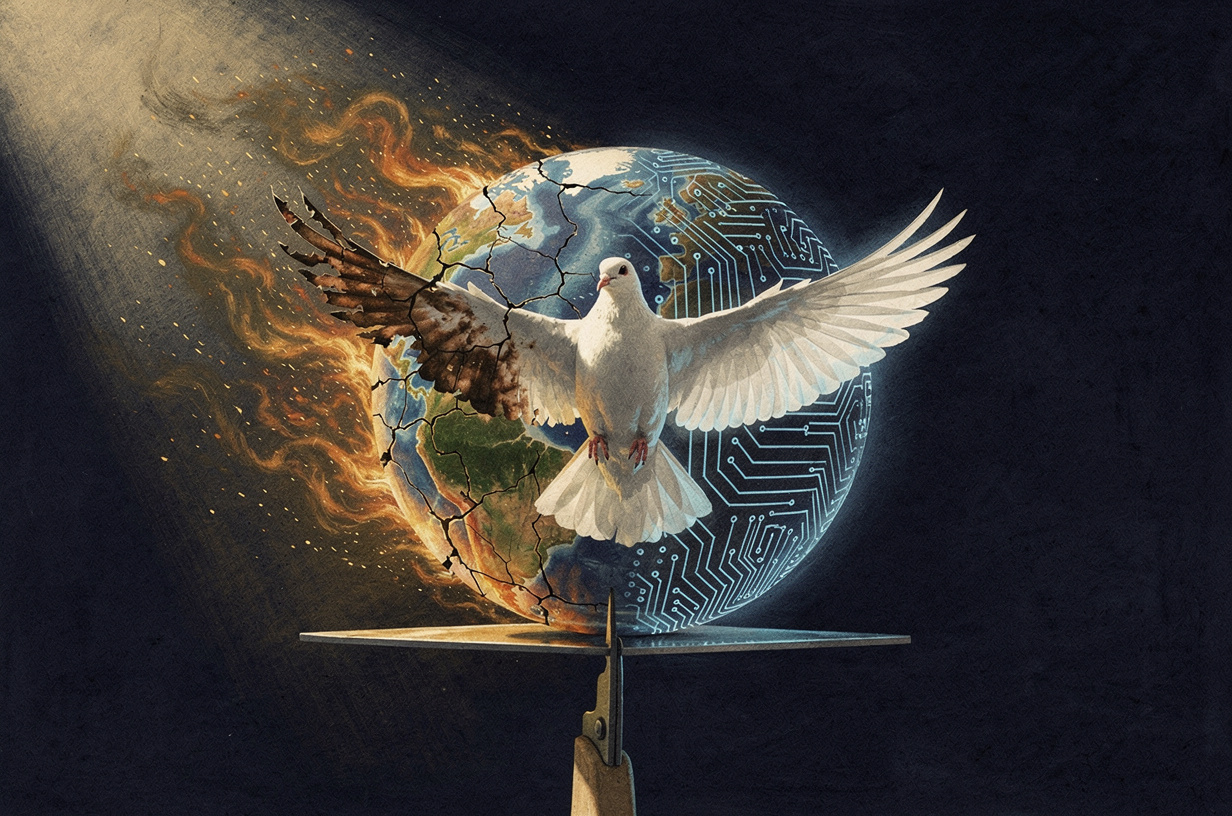
“Iran is now threatening both the maritime chokepoint and its overland alternative simultaneously.”
How this was made Verified AI
Every Intellegix briefing is generated from that day's broadcast and run through automated checks before it publishes — with a human paged on any flag. Here is the trail for this edition.
Iranian Missiles Hit Saudi Oil Targets as Ceasefire Proposal Emerges

Iran launched ballistic missiles overnight at three Saudi targets with direct implications for global energy supply: Prince Sultan Air Base southeast of Riyadh, Yanbu port on the Red Sea coast, and the SAMREF refinery — a joint Saudi Aramco and ExxonMobil operation that processes crude for export to Asia. The Yanbu strike is particularly alarming because the port anchors a critical pipeline built to bypass the Strait of Hormuz, meaning Iran is now threatening both the maritime chokepoint and its overland alternative simultaneously.
The conflict has already knocked roughly five million barrels per day out of global markets, driving refining margins to record highs. Yet oil prices pulled back Tuesday morning on a diplomatic signal: mediators reportedly including Qatari and Omani intermediaries have formally placed a ten-day ceasefire proposal on the table, and Iran has confirmed receiving it.
Secretary of State Rubio confirmed that Gulf states have pledged substantial U.S. investment in exchange for American protection of the Strait of Hormuz — an explicit protection-for-payment arrangement that complicates any ceasefire negotiation by deepening U.S. financial entanglement with Gulf security. Adding to the uncertainty, an Israeli intelligence report claims that Mojtaba Khamenei — son of Supreme Leader Ali Khamenei and widely considered his intended successor — has been wounded and is being managed by the IRGC inside Iran. Independent verification of the claim is still outstanding, but if accurate, it raises urgent questions about succession and who on the Iranian side is empowered to agree to any pause in hostilities.
The Pentagon simultaneously confirmed undisclosed American troop injuries from Iranian strikes, framing the delayed disclosure as operational security. Senator Curtis of Utah, a Republican, has called for full transparency after two U.S. service members were killed over the weekend. The financial dimension is equally stark: the Pentagon has formally warned Congress it faces a cash shortfall that could threaten troop pay within weeks, and Defense Secretary Hegseth is scheduled to appear before the Senate this week to defend an $87.6 billion emergency war funding request. Representative John Larson of Connecticut has announced a lawsuit to block funding for the war entirely on constitutional grounds, arguing Congress never authorized military action against Iran — a challenge that carries legal weight given the War Powers Resolution's sixty-day clock, now on day nine.
NATO Allies Refuse to Join the Fight as World Cup Delivers Awkward Diplomacy

The Iran conflict is fracturing Western alliances in ways that will outlast any ceasefire. Both the United Kingdom and Germany have explicitly rejected Trump's suggestion that NATO should play a formal role in the war, with language from London and Berlin described as unusually direct: the conflict, they said, has nothing to do with NATO. European allies have long held that the alliance is a defensive compact for the Euro-Atlantic area, not a global expeditionary force, and neither Germany nor the UK were consulted before U.S. military operations commenced.
Qatar's role in the crisis carries a pronounced paradox. The country is serving as one of the key mediation channels for the ceasefire proposal while simultaneously being the source of a Boeing 747 gifted to President Trump that he has been using as an unofficial Air Force One. The White House confirmed Tuesday the Qatari-donated aircraft will undergo defensive security upgrades this fall. The optics of a major mediating power having given the sitting U.S. president a luxury jet worth hundreds of millions of dollars are, by any diplomatic standard, awkward.
The World Cup final provided the week's most unexpected political theater. Trump attended the closing ceremony and was audibly booed by sections of the international crowd. He also shook hands with Spanish Prime Minister Pedro Sánchez — who has been the target of U.S. tariff threats for months — in an exchange described as brief and visibly strained. Some European diplomats are nonetheless reading the fact of the handshake as a small signal that communication channels remain open despite the trade tensions.
Elsewhere in the international picture, Nicaragua's President Daniel Ortega declared during a speech marking the forty-seventh anniversary of the Sandinista revolution that Nicaragua will never hold elections again — a formal declaration of permanent authoritarian rule. In U.S. federal court, Sinaloa Cartel co-founder El Mayo Zambada was sentenced to life in prison, a significant law enforcement milestone. And Estonia is urging the European Union to impose deeper sanctions on Russia following what it described as the largest single missile barrage on Kyiv since the war began — an escalation timed, some analysts believe deliberately, to coincide with Western attention being fixed on the Persian Gulf.
War Powers, Party Fractures, and a $4 Billion Corruption Allegation
The Iran war is scrambling domestic American politics along lines that defy standard partisan sorting. Senator John Curtis of Utah — a Republican — has placed the administration on notice that its information management around troop casualties is unacceptable, even as his party is simultaneously being asked to vote on $87.6 billion in supplemental war funding within weeks. The constitutional authorization question, meanwhile, gives members of both parties an avenue for a more principled stand: the War Powers Resolution's sixty-day clock began on day one.
On the Democratic side, Michigan Senate candidate Abdul El-Sayed had a visibly uncomfortable appearance on CNN Tuesday when anchor Jake Tapper pressed him on leaked audio in which he allegedly instructed staff to avoid commenting on Khamenei's death. El-Sayed deflected repeatedly. Michigan's large Arab American and Muslim American population makes the Iran conflict an acute electoral challenge for Democratic candidates in that state.
Bernie Sanders brushed off House Minority Leader Hakeem Jeffries' plea to stop backing primary challengers against incumbent Democrats, underscoring a deepening factional conflict within the party heading toward the midterms. In a separate development, Senate Democrats released a formal minority report accusing the Trump family of generating four billion dollars in profits tied to positions of executive power since taking office — covering real estate deals, foreign investments, and what Democrats describe as monetization of executive authority. The administration is expected to dismiss the report as political theater, but the specificity of the figure will drive sustained scrutiny.
A federal judge dismissed the DOJ's lawsuit against Minnesota's sanctuary policies, ruling the government failed to demonstrate a conflict with federal law that courts could remedy — continuing a pattern of judicial losses for the administration on immigration enforcement. Separately, the Supreme Court agreed to hear the case of an Alaskan pilot whose $95,000 Cessna was seized because a passenger carried a six-pack of beer. The case will force the Court to clarify the Eighth Amendment's Excessive Fines Clause and could significantly constrain how law enforcement agencies across the country deploy civil asset forfeiture as a revenue tool.
Musk Attacks Silicon Valley Culture as a $1.65 Trillion AI Debt Comes Into Focus

Elon Musk publicly described the culture at U.S. AI firms as pretentious and poisonous — a broadside directed, by context, at companies including OpenAI, Google DeepMind, and Anthropic, all of which compete directly with his own xAI. Musk simultaneously dismissed a report that SpaceX had ordered $52 billion worth of AI server racks from Foxconn, calling the story fake news on X. The denial moved markets: Dell and Super Micro, traditional AI server suppliers to SpaceX, rose on the news that the Foxconn deal — which would have redirected that business — apparently did not exist.
The more consequential policy development is the Trump administration's reported consideration of a de facto ban on Chinese AI models, primarily targeting DeepSeek — which is on the verge of releasing its fourth major version — and Alibaba's Qwen series, whose Qwen 3.8 model was unveiled this week. The national security rationale centers on the risk of data collection or influence operations embedded in models trained under CCP influence. But the economic counterargument, articulated bluntly by investor Chamath Palihapitiya and echoed by Jack Dorsey and David Sacks, is that DeepSeek's open-source releases have dramatically lowered AI inference costs globally. Banning Chinese models without equally capable American open-source alternatives would force U.S. companies to pay OpenAI or Anthropic API prices while Chinese competitors operate at near-zero marginal cost.
A Nikkei analysis put a concrete number on the financial stakes of the broader AI investment race: $1.65 trillion in what it calls hidden debt — capital expenditure commitments, long-term data center leases, and GPU purchase agreements that don't appear cleanly on traditional balance sheets but represent real financial obligations. The concern is not that the investments are wrong but that if AI revenue doesn't scale quickly enough, some companies face a genuine liquidity crunch.
Oracle is the current cautionary data point. Its stock hit a 52-week low this week while its credit default swap costs — the market's insurance against the company failing to service its debts — reached a record high. Rising CDS costs signal that sophisticated investors are pricing in a meaningfully elevated probability of Oracle financial distress, a double warning sign heading into earnings season. A separate data-sourcing controversy also emerged: Google's AI is reportedly pulling from Facebook data to answer millions of user queries, creating a data value chain that existing intellectual property agreements were not designed to govern and that analysts say could form the basis of future litigation.
Chip Stocks Surge as a $15 Million Startup Takes Aim at Nvidia's Software Moat

Taiwan's Taiex posted its largest single-day point gain in the index's history Monday, driven almost entirely by semiconductor stocks recovering from last week's selloff. The catalyst was an AMD-Microsoft AI deal — full terms undisclosed — in which AMD will provide custom AI accelerators for Microsoft's Azure infrastructure, lifting the entire sector out of what had technically been bear market territory.
The deal's significance extends beyond the financial signal. Nvidia has dominated AI compute for years, primarily through CUDA — its proprietary software development environment that makes its chips far easier to program for AI workloads. Every hardware competitor faces the same structural problem: performance may be comparable, but developers who have built on CUDA face significant cost and effort to migrate. A fifteen-million-dollar startup called Infinity has raised capital specifically to address this bottleneck, building an alternative developer environment that would allow AI code to run on non-Nvidia hardware without substantial modification. Fifteen million dollars is an early-stage bet against a moat Nvidia has spent two decades constructing, but the strategic logic mirrors how platform lock-in has been broken historically — through software compatibility rather than hardware performance alone.
ASML, whose extreme ultraviolet lithography machines are the single most critical bottleneck in advanced chip production globally, announced it is offering every employee a twenty-thousand-euro stock bonus vested through 2030, a total commitment of roughly nine hundred million euros. The move is an attempt to lock in its entire workforce at a moment when AI-driven semiconductor demand is surging and ASML's machines are effectively irreplaceable.
Google is separately developing a chip that would bake its Gemini AI directly into silicon — moving AI inference from the cloud to the device level, following the trajectory Apple established with its Neural Engine. If successful, the approach would reduce Google's dependence on cloud compute costs and create hardware differentiation that is difficult to replicate. On the consumer hardware side, code strings in a leaked iOS 27 beta four build reference plural battery systems within a single iPhone casing — a strong technical indicator of a foldable form factor, since dual batteries are a near-prerequisite for powering both sides of a folding display.
Dimon Wouldn't Buy Stocks Here — and Hedge Funds Are Listening

S&P futures were up roughly forty points Tuesday morning, reflecting tentative optimism from the ceasefire proposal and the chip stock recovery. The broader picture being painted by institutional money is considerably more guarded. JPMorgan Chase CEO Jamie Dimon — whose bank just reported record quarterly profits — said publicly he would not personally buy stocks or bonds at current prices, citing investor underpricing of both geopolitical risk from the Iran conflict and fiscal risk from the federal deficit. Dimon's macro warnings have historically aged well, and Goldman Sachs data shows hedge funds are simultaneously dumping U.S. tech stocks at a record pace.
The result is a bifurcated market: genuine near-term AI enthusiasm driving chip stocks higher while sophisticated institutional money reduces tech exposure on macro grounds. These conditions can coexist for extended periods, but the divergence is a signal worth monitoring.
A federal judge froze the $111 billion Paramount-Warner Bros. merger pending antitrust review, leaving two of the largest remaining traditional media conglomerates in legal limbo. The regulatory concern centers on content concentration: combining HBO, Warner Bros., Paramount Pictures, CBS, and their combined streaming libraries would create an entity with enormous leverage over cable providers, streaming platforms, and distributors.
Trump signed a proclamation offering conditional tariff cuts to spur domestic aluminum smelter investment — using the tariff lever not as a blunt protectionist tool but as an inducement contingent on verifiable investment commitments. The European Union separately banned the destruction of unsold clothing and shoes, a regulation that will require major fashion retailers selling into European markets to donate, recycle, or repurpose inventory rather than incinerate or shred it. And in a cost-of-living milestone, Miami has surpassed New York City in overall expense for the first time in recorded history, driven by post-pandemic migration of high-income workers to Florida and constrained housing supply in desirable neighborhoods.
A 'Dead' Coral Reef Is Alive, NASA Holds Its Artemis Line, and Federal Science Faces a Political Threat

Marine biologists using underwater drones have discovered a thriving mesophotic coral ecosystem on the Gulf of Guinea continental shelf off the coast of Benin — a reef presumed dead or non-existent for sixty years based on earlier surveys. Mesophotic reefs exist at depths between roughly thirty and one-hundred-fifty meters, where reduced thermal stress from surface warming events may allow survival long after shallower reefs have bleached and died. The finding raises the possibility that other reef systems written off in understudied ocean zones may similarly persist, and could shift both scientific attention and conservation funding toward deeper ecosystems.
NASA's administrator stated that the Artemis III crewed lunar landing mission remains on track despite a Blue Origin explosion — significant because Blue Origin's Blue Moon lander is a key component of the mission. Whether the explosion affected systems critical to the Artemis timeline, or whether NASA is managing congressional expectations to avoid budget and schedule panic, remains unclear. The Artemis program has already slipped its schedule multiple times.
Trump ordered a probe of the National Academy of Sciences, accusing it of issuing fraudulent climate guidance and implicitly threatening its federal funding. The NAS is a private nonprofit chartered by Congress to provide independent scientific advice — not a government agency — and previous administrations, even skeptical ones, generally avoided direct accusations of fraud against it. Conditioning federal NAS funding on changes to its scientific conclusions would represent a direct interference with institutional scientific independence with significant implications for how the U.S. is perceived internationally as a science-based regulatory environment.
A Senate bill to overhaul FCC broadband maps passed with bipartisan support. Current maps rely on self-reported data from internet service providers with an obvious incentive to claim coverage in areas they don't adequately serve, and federal broadband infrastructure funding is allocated on that basis — meaning rural and underserved communities routinely miss out on investment they are entitled to. Accurate maps are a prerequisite for fixing the underlying problem. Post-tropical cyclone Elida was also driving unusual humidity and high surf along the California coast, with a high surf advisory in effect through Tuesday night for areas that rarely see tropical-origin swells.
Adidas Shuts Nike Out, Sony Seeks $4.5 Billion From an AI Music Startup, and a Hard Look at the AI Investment Thesis
Adidas locked Nike out of the World Cup final stage entirely — every kit, official uniform, and on-pitch branding element carried the Adidas mark, representing a significant competitive coup in a branding cycle that repeats only every four years. The tournament's economic returns for host cities were less triumphant: a Deloitte study found Mexico saw visitor numbers approximately forty percent below pre-tournament projections, and several U.S. host cities along with Vancouver reported disappointing returns. The pattern is consistent with a well-documented tendency for mega-event economic projections — typically generated by boosters with incentives to win hosting rights — to substantially exceed actual visitor spending.
Philadelphia Eagles head coach Nick Sirianni confirmed he is using ChatGPT to prepare for the 2026 NFL season, signaling that AI-assisted coaching preparation is becoming normalized at the professional level. Sony Music, meanwhile, filed a separate lawsuit against AI music startup Udio after a judge declined to expand the original case, alleging that Udio copied thirty thousand, one hundred seventeen specific copyrighted tracks and seeking up to $4.5 billion in damages. The specificity of that track count suggests Sony conducted substantial forensic analysis of Udio's training data; the case will be one of the defining legal tests for AI-generated music and the copyright status of AI training data.
Bloomberg reported that Apple deliberately excluded designer Jony Ive from its lawsuit against OpenAI despite his involvement with the company, a calculation reportedly involving both his limited operational role and his close personal friendship with Laurene Powell Jobs. Suing Ive would have generated a qualitatively different public narrative, and Apple apparently judged the reputational costs prohibitive.
The most consequential analytical question of the segment concerns the AI investment thesis itself. The dominant assumption in financial and technology analysis is that $1.65 trillion in infrastructure commitments will be justified by AI productivity and revenue gains. The strongest counterarguments: large language model architectures may face capability limits not solved by additional compute; copyright and data-rights litigation — actively playing out in the Sony-Udio case — could dramatically raise training costs; and enterprise AI adoption could stall due to implementation complexity. Two concrete indicators to watch when third-quarter earnings arrive: renewal rates for AI software subscriptions such as Microsoft Copilot and Salesforce Einstein AI, and gross margin trajectory at major cloud providers. If AI workloads are compressing margins rather than expanding them, that directly contradicts the standard investment pitch.