Webb Telescope Finds Water Near the Galaxy's Most Extreme Address
How this was made Verified AI
Every Intellegix briefing is generated from that day's broadcast and run through automated checks before it publishes — with a human paged on any flag. Here is the trail for this edition.
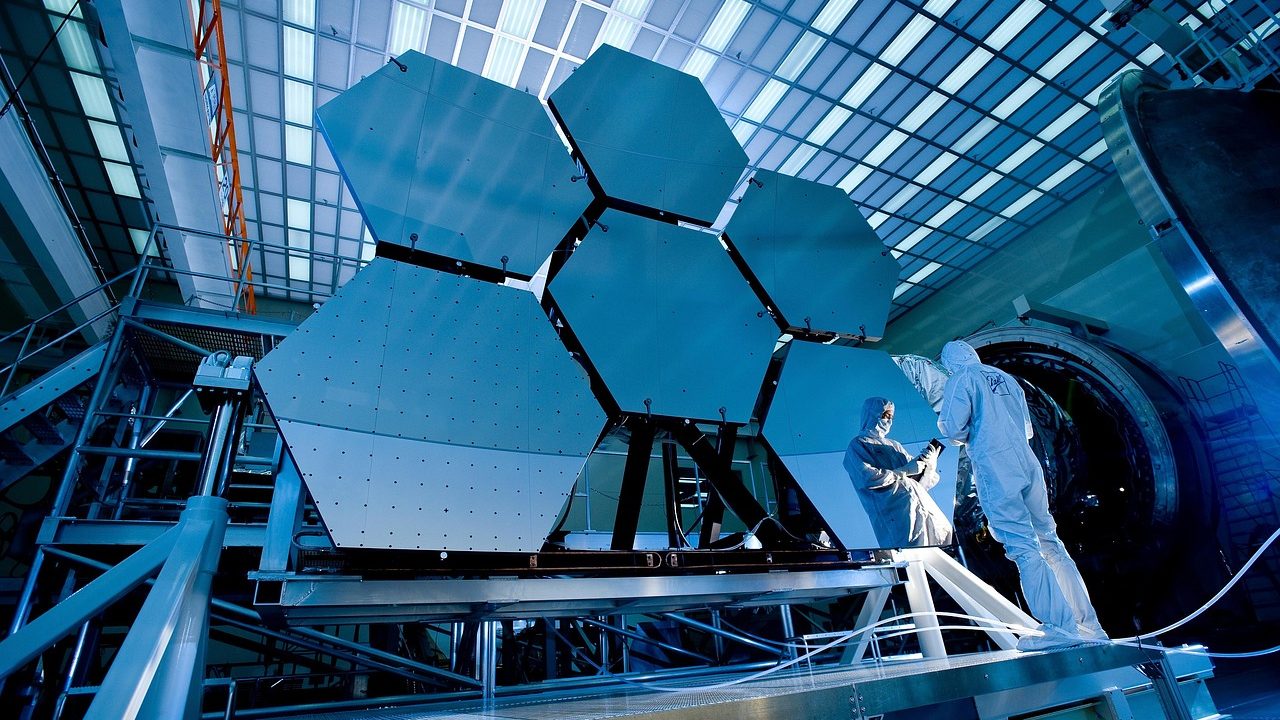
Astronomers using the James Webb Space Telescope detected water molecules and dust surrounding a dying star — an asymptotic giant branch star in the final phase before becoming a white dwarf — at a distance of just 0.55 light-years from Sagittarius A*, the supermassive black hole at the center of the Milky Way. The finding was described as scientifically significant and underreported relative to its implications.
Sagittarius A* carries a mass approximately four million times that of the sun. The radiation environment at the galactic center — X-rays, ultraviolet radiation, cosmic rays — is orders of magnitude more intense than the relatively quiet outer-disk region where Earth's solar system resides. Conventional models predicted that complex molecules such as water, which require specific temperature and pressure conditions to form and persist, would be destroyed by that radiation before accumulating in detectable quantities. The Webb detection suggests either that models of radiation shielding within stellar envelopes are incomplete, or that chemical and physical processes protecting these molecules have not been fully characterized.
The implications for the search for habitable environments are meaningful in scope if not in simple optimism. The standard model of habitability has been calibrated on conditions in the solar neighborhood. If water can survive near Sagittarius A*, the universe's capacity to generate and sustain the chemical precursors of life is wider than previously modeled — though the radiation itself would likely remain lethal to Earth-like biology. What shifts is the boundary condition for where searches should be directed, and the understanding of water as a molecule considerably more resilient than assumed.
The Webb telescope has now accumulated years of operation producing findings that revise fundamental assumptions. The galactic center result is, in that sense, consistent with its record: a properly calibrated instrument pointed at the universe returns information about where existing models are wrong — a form of scientific progress that is disorienting and clarifying in equal measure.