From Punched Cards to Trillion-Parameter Models: Computing's Long Memory
How this was made Verified AI
Every Intellegix briefing is generated from that day's broadcast and run through automated checks before it publishes — with a human paged on any flag. Here is the trail for this edition.
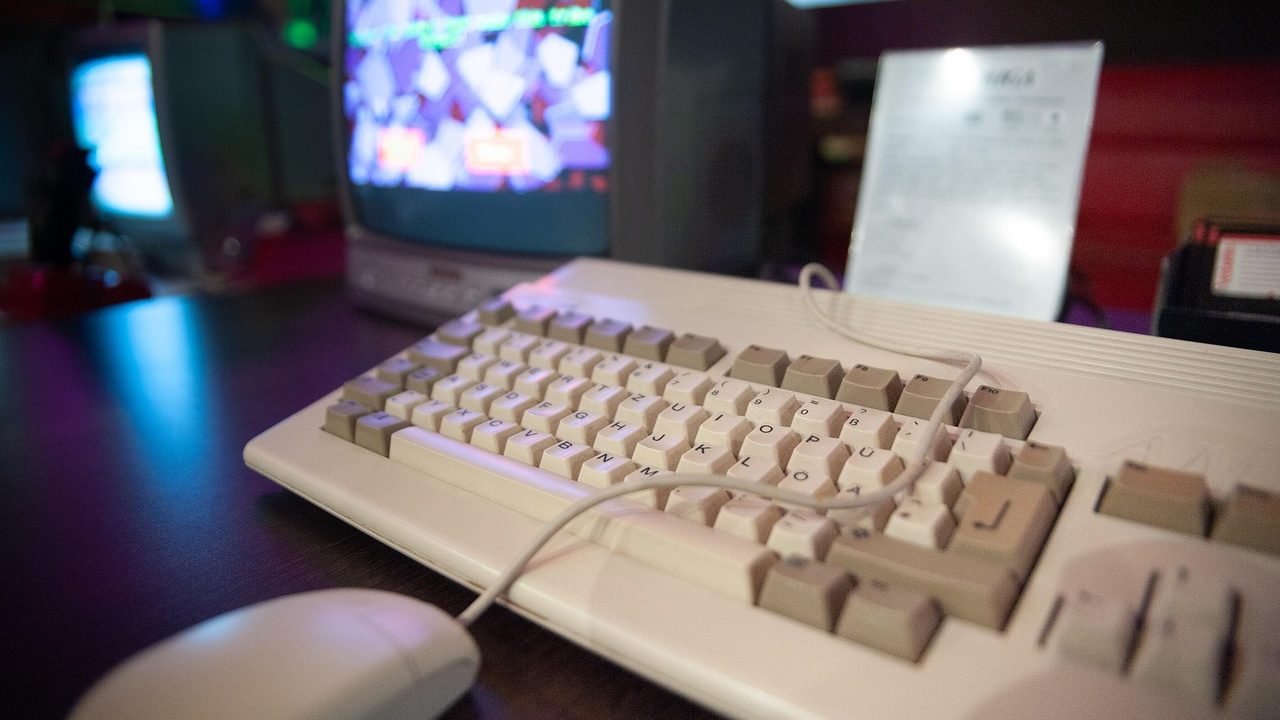
Tim King, who wrote AmigaDOS — the disk operating system for the Commodore Amiga, launched in 1985 — died this week. The Hacker News thread remembering him carried the particular quality that surfaces when the community is paying tribute to foundational work: 34 comments largely from people who used Amiga systems in their formative years, reflecting on hardware that ran genuine multitasking, audio, and video capabilities years ahead of what Apple and IBM were shipping to consumers. The code King wrote survives; the knowledge of why specific decisions were made, what constraints shaped them, and what alternatives were abandoned does not.
The IBM PC's 45th anniversary — the original machine was released August 12th, 1981, in Boca Raton, Florida — anchored a companion piece covering the Model F keyboard that shipped with the XT variant. Among mechanical keyboard enthusiasts, the Model F carries a specific reverence: the switches were built to IBM's manufacturing standards from an era when IBM was considered the most rigorous hardware company in the world, designed for hundreds of millions of keystrokes. Forty-five years separates that beige box from the mixture-of-experts models dropping overnight on August 13th, 2026 — a span in which the computing stack has changed so completely that the continuity is almost philosophical.
A piece from Oleg Kiselyov's site — a researcher whose work on functional programming and type systems carries significant weight in that community — argued that Whitehead and Russell's Principia Mathematica, published in 1910, contains insights that remain fresh and underappreciated, particularly the type hierarchy Russell constructed to avoid logical paradoxes. Kiselyov's claim is that this hierarchy has direct technical descendants in modern dependent type systems and proof assistants — connections that are substantive rather than merely historical.
A piece on the nineteenth-century Antiqua-Fraktur dispute offered a different kind of historical resonance. Germany's century-long conflict between Gothic Fraktur script and Roman Antiqua script — nationalists associating Fraktur with German identity, modernizers viewing Antiqua as the path to readability and international communication — was ultimately resolved when the Nazi government banned Fraktur in 1941 on the grounds that it was a 'Jewish invention,' a historically false claim that illustrated how completely the typographic debate had become detached from any rational foundation by that point.
IBM's own history archive contributed a piece on Herman Hollerith's punched card tabulator, used to process the 1890 U.S. Census. Hollerith's company eventually became part of IBM. Joel David Hamkins, a set theorist and philosopher of mathematics at Notre Dame, contributed a post on the lattice of sets of natural numbers, arguing that this elementary-seeming object contains copies of essentially every countable partial order — a result in the category of beautiful mathematics pursued for its own sake. Together, the day's history pieces placed the overnight AI model race in a longer arc: from mechanical card sorting to trillion-parameter language models in roughly four decades.