Mass Deportation Hearings, a $9.16 Billion Budget, and a 27-Year Development Saga's Latest End: San Diego, June 16, 2026
San Diego's immigration courts are conducting mass proceedings that advocates say are engineered to generate automatic deportation orders against people who never knew their hearing dates had moved — one of several stories reshaping life across the county on Tuesday, June 16, 2026.
How this was made Verified AI
Every Intellegix briefing is generated from that day's broadcast and run through automated checks before it publishes — with a human paged on any flag. Here is the trail for this edition.
Inside San Diego's 'Mega Master' Hearings: How Rescheduled Court Dates Become Deportation Orders

San Diego's immigration courts are now conducting what advocates call 'mega master' hearings — mass proceedings in which more than fifty individuals appear before a single judge simultaneously. In some jurisdictions nationally, the number has exceeded a hundred. The volume itself is alarming, but the more consequential issue, according to reporting by KPBS, is timeline compression: many respondents originally had hearings scheduled for 2027, 2028, or even 2029, dates that existed because of a years-long court backlog. Under the Trump administration's push to accelerate deportations, those future dates are reportedly being moved forward, sometimes by years, with advocates saying individuals received little to no advance notice.
The legal consequence of missing a rescheduled hearing is automatic. Under immigration law, failure to appear at a master calendar hearing results in an in-absentia removal order — a deportation order issued without the respondent present to contest it. The National Immigration Project has described the practice as 'designed to boost the number of deportation orders automatically,' a direct accusation that scheduling itself is being used as an enforcement tool.
Immigration attorneys in San Diego face a compounding difficulty: they cannot file appearances for every client whose date might suddenly shift, particularly when notification does not arrive through the standard Notice to Appear process. Advocates are pursuing emergency court interventions and motions to reopen cases after deportation orders are issued, but those motions carry their own procedural hurdles — and the orders stand in the meantime.
Two additional enforcement developments round out an unusually intense week for immigration news in the county. KPBS is reporting that dozens of immigrant arrests have occurred at entrances to San Diego-area military bases since President Trump returned to office in January 2025 — a practice that was reportedly rare before that date, given the distinct protocols historically governing civil immigration enforcement near federal installations. Separately, a federal judge has ordered an immigrant detention facility to allow a San Diego County health inspection, an order that implies concerns serious enough to require judicial compulsion for what would ordinarily be routine access.
Underlying all three stories is the ongoing Tijuana sewage crisis, which shapes how the U.S. and Mexico are able to coordinate on transboundary infrastructure. The collapse of the Insurgentes Collector pipe in eastern Tijuana has produced an estimated eleven million gallons per day of raw sewage flowing into the Tijuana River Valley and ultimately into the Pacific Ocean off Imperial Beach. San Diego County, all eighteen of its cities, and numerous school districts have formally declared the situation an emergency.
Supervisors Near Adoption of $9.16 Billion Budget, with South Bay Sewage Relief and a Detention Forum Tonight

The San Diego County Board of Supervisors is in the final stretch of adopting a $9.16 billion budget for Fiscal Year 2026-27, with final deliberations scheduled for June 25 at 9 a.m. at the County Administration Center. The spending plan is six percent larger than the current year — a $522.5 million increase — and its priorities reflect the Board majority's focus on behavioral health, fire resilience, and the escalating costs of the Tijuana sewage crisis.
The budget allocates $176 million for behavioral health treatment, $93.1 million for affordable and supportive housing, $265.9 million for road safety and maintenance in unincorporated communities, and $84.5 million to strengthen firefighting and emergency medical services in areas such as Alpine, Ramona, and Lakeside that lack a city fire department. Safety-net programs — CalFresh, CalWORKs, Medi-Cal, and general relief — receive $852 million. Library operations countywide are funded at $71.5 million.
Directly tied to the Tijuana sewage emergency, the budget earmarks $25.6 million for watershed protection to reduce ocean pollution, a longer-term infrastructure commitment following a 3-2 party-line vote earlier this year that approved $8.8 million in South Bay sewage relief. Chair Terra Lawson-Remer, Vice Chair Monica Montgomery Steppe, and Chair Pro Tem Paloma Aguirre formed the majority on that prior vote.
At the city level, the San Diego City Council last month enacted 25 amendments to its Accessory Dwelling Unit regulations. Changes include requiring four-foot side and rear setbacks for ADUs in High or Very High Fire Hazard Severity Zones and allowing ADUs to be subdivided into condominium units and sold separately under Assembly Bill 1033 — a new ownership pathway that could expand access for moderate-income buyers. The city navigated state housing officials' concerns that some earlier proposed changes conflicted with California law, which would have triggered a loss of state funding.
Tonight, the San Diego County Sheriff's Office hosts a public forum from 6 to 8 p.m. at the Encinitas Community Center on the future of the Vista Detention Facility, a structure built in 1972 that the county is weighing modernizing. Decisions about its size, capacity, and programming will shape Sheriff's Office infrastructure for decades — and given the week's immigration enforcement news, questions about who is detained there and under what conditions are likely to feature prominently.
San Diego's $1.1 Million 'Holding Pattern': Low Inventory Traps Buyers and Sellers Alike

San Diego County's housing market has settled into what the Greater San Diego Association of Realtors is calling a 'holding pattern' — a phrase that captures the surface calm while obscuring the pressure beneath. The median sales price for single-family detached homes held at $1,099,500 in May 2026, essentially unchanged from April and March. The countywide median across all residential properties has now sat at $900,000 for thirteen consecutive months.
The inventory figures tell the more consequential story. Residential inventory has fallen for four consecutive months: down 12.4 percent in May year-over-year, 12.8 percent in April, 11.2 percent in March, and 15.4 percent in February. In North County, inventory is reportedly down nearly thirty percent compared to this time last year. The dynamic is self-reinforcing: sellers decline to list because they would re-enter the same expensive market as buyers, while buyers cannot clear the barrier of a 20 percent down payment on a home priced above one million dollars.
Mortgage rates in the low-to-mid six percent range — down roughly half a point from a year ago — have not been sufficient to break the standoff. The one segment showing movement is attached homes: condo and townhome sales were up four percent year-over-year in May, while detached home sales fell 1.9 percent, suggesting that buyers who can act are shifting toward more accessible price points.
The county's $93.1 million affordable and supportive housing allocation in the FY 2026-27 budget and the city's ADU reforms represent the policy levers local government is pulling to build supply at the lower end of the market. Whether those tools are adequate against a baseline median of $900,000 remains an open question — and the families who need affordable housing now face years of permitting and construction timelines before any new supply materializes.
The Tijuana sewage crisis adds a direct economic dimension to the coastal housing picture. Beach closures in Imperial Beach have suppressed revenue for businesses tied to tourism, fishing, and coastal recreation. The $25.6 million watershed protection allocation in the county budget is partly an economic calculation: every month the beaches remain closed represents losses that do not come back.
Fanita Ranch Blocked for the Fifth Time in 27 Years as Santee Advances License Plate Cameras and a New Community Center
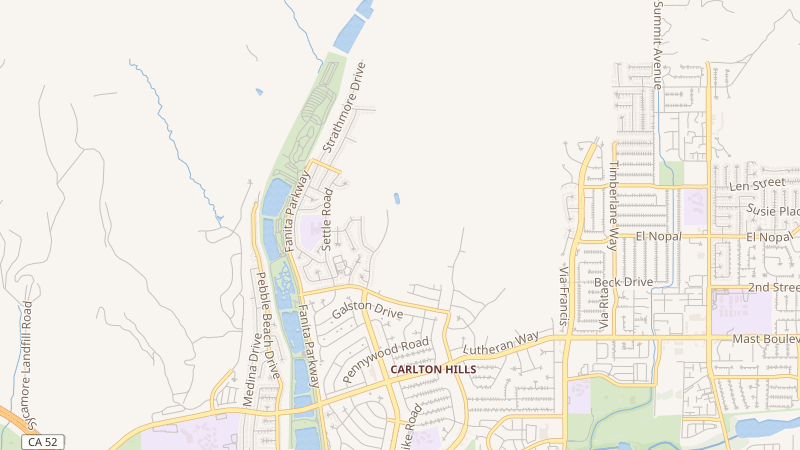
The Fanita Ranch development proposal — first introduced in 1999 — has suffered its fifth consecutive court defeat. The San Diego Superior Court and California's Fourth District Court of Appeal issued concurrent rulings in early June finding that the Santee City Council attempted to circumvent its own general-plan amendment rules to avoid triggering a voter referendum on the project. Under Santee's city charter, certain land-use changes require voter approval; both courts found the council's approval routing was improper. The project would have placed approximately 3,000 homes across 2,600 wildfire-prone acres in the city's northwest.
Environmental groups Preserve Wild Santee and the Center for Biological Diversity, which have litigated the project for years, described the ruling as protecting residents from wildfire risk and upholding local land-use law. The legal record across five defeats over 27 years reflects the difficulty of large-scale hillside development in a region with serious wildland fire exposure — illustrated just three weeks ago when the Border 6 Fire burned 2,525 acres in nearby Dulzura.
With Fanita Ranch blocked, Santee's housing future likely depends on infill development along the Santee Town Center corridor and areas served by the trolley extension. That conversation will be shaped in part by the November 3 City Council elections, with Districts 1 and 2 on the ballot.
On public safety technology, Santee officials are advancing an Automated License Plate Reader program: six cameras on a one-year, $18,000 contract connecting into an existing countywide network that already includes cameras at Las Colinas Detention Facility. Privacy advocates have raised concerns about data retention policies, access controls, and whether the data could be used beyond its stated law-enforcement purpose — questions the city will need to answer publicly before the program is fully operational. The ALPR network's connection to shared county infrastructure is particularly relevant given the week's immigration enforcement context.
On a more optimistic note, construction is underway on a long-promised community center near the Cameron YMCA at 101 Riverwalk Drive. The City Council unanimously approved the $26.8 million agreement last December. The planned facility will be 12,500 square feet across two stories, funded through $14 million in development impact fees, a $4.5 million state grant, and a $6.6 million draw from the city's general fund. For a city that has needed this facility for years, shovels are finally in the ground.
Civil Grand Jury Finds Grossmont School Board Made Mental Health Decision Based on 'Falsehoods' — But What Comes Next Matters Most
A San Diego County civil grand jury report published June 4 found that the Grossmont Union High School District governing board's 2023 decision to change mental health providers was based on — in the grand jury's own language — 'falsehoods and misrepresentations' about care being provided to LGBTQ+ students. The practical consequences of that decision were measurable: students across the district were left without access to six mental health clinicians and without a suicide prevention program for four full months.
The report makes ten recommendations, including allowing San Diego Youth Services to provide mental health services to three East County high schools through its East County Behavioral Health Clinic, an agreement currently running through June 2027. The district has 90 days from June 4 to formally respond to the grand jury's findings.
The grand jury report sits within a broader pattern of controversy at the district. Nine former school librarians — whose positions were eliminated entirely by a 4-1 board vote last March, with the stated rationale of closing a $2.4 million budget gap — have filed suit in San Diego Superior Court alleging that the board majority has an anti-LGBTQ+ and anti-diversity agenda. A second suit has been filed by Tenzin Peling, a former director in the district's Special Education Department, raising similar concerns. Both lawsuits are in early stages; no court has made findings.
The narrative surrounding GUHSD has a compelling shape: a board majority made a decision that harmed students, reportedly based on false information. But the board members involved have not conceded that their stated concerns about the previous provider were fabricated — they dispute the grand jury's framing. Grand juries do not hear cross-examination, and their findings, while serious, represent one interpretation of a complex institutional decision. What is not disputed is the operational gap itself: four months without six clinicians and without a suicide prevention program is a concrete harm, regardless of intent.
The signal to watch is the district's formal response, due around early September — just as schools reopen for fall. If the board substantively engages with the ten recommendations and agrees to extend San Diego Youth Services access beyond June 2027, that constitutes a meaningful concession. A primarily legalistic or defensive response would indicate the board intends to contest rather than correct the findings. Amid the governance controversy, 4,725 students graduated from GUHSD's nine comprehensive high schools and affiliated programs on June 3 and 4 — including graduates from Santana High School and West Hills High School in Santee.
Padres Held to One Hit, Beach Hazards Statement Extended Through Friday, and the Week Ahead

Monday night in St. Louis was a difficult evening for the Padres: Cardinals starter Dustin May carried a perfect game into the seventh inning and finished with a complete-game one-hitter, with San Diego falling 3-0. Jimmy Crooks contributed a two-run double and Alec Burleson added an RBI single for St. Louis. The loss drops the Padres to 37-34. Manager Craig Stammen served a one-game suspension Monday — stemming from a June 13 incident at Camden Yards in which reliever Ron Marinaccio was found to have intentionally hit Orioles shortstop Gunnar Henderson — with bench coach Randy Knorr managing in his absence.
Catcher Freddy Fermin remains on the 7-day concussion injured list after taking a warmup pitch to the head during Saturday's Baltimore game. Shortstop Xander Bogaerts was also hit by a pitch in the Camden Yards incident but reportedly stayed in the game and had not been placed on the injured list as of Tuesday morning, though his status bears monitoring. Game 2 of the three-game series at Busch Stadium is set for 7:45 p.m. Eastern on Cardinals.TV and Padres.TV, with Michael King (4-5, 3.46 ERA) going for San Diego against Cardinals starter Antonio Pallante (7-4, 3.88 ERA).
Away from baseball, the week's outdoor forecast carries a significant public safety warning. A Beach Hazards Statement is in effect through Friday evening, June 19, for all San Diego County coastal areas. South and southwest swells of 3 to 6 feet, with sets reaching 7 feet, are generating high rip current risk and strong longshore currents. Lifeguards have made approximately 270 rescues along county beaches since Sunday. Water temperatures range from 65 to 70 degrees. Anyone who is not a strong swimmer is urged to stay out of the water; those who do visit the beach should swim only within sight of a lifeguard tower.
Inland, Tuesday brings clouds through mid-morning clearing to mostly sunny skies by the afternoon, with a high near 75 degrees and northwest winds of 5 to 10 miles per hour gusting to 20. A cooling trend arrives Thursday and Friday, with Juneteenth Thursday seeing a high near 72 degrees and Friday night lows dipping to around 62. No rain is expected through the weekend.
Looking ahead on the civic calendar: the Vista Detention Facility public forum runs tonight from 6 to 8 p.m. at the Encinitas Community Center; Thursday is Juneteenth, a federal and state holiday; and San Diego Fire-Rescue officials are actively urging residents to attend professional fireworks shows rather than use backyard or illegal fireworks ahead of July 4th, with three wildfires already linked to fireworks in recent weeks across the county. The Genasys Protect app is the recommended tool for monitoring fire risk by neighborhood.