Kami, Shrines, and Sacred Nature: An Introduction to Shinto
Shinto, Japan's indigenous spiritual tradition, centers on the veneration of kami — sacred spirits understood to dwell in natural phenomena, ancestors, and significant places. This episode explores how Shinto shapes everyday Japanese life through ritual purity, shrine practice, and festivals, tracing its ancient roots while examining how it has evolved alongside Buddhism and modernity. We'll unpack key concepts like musubi (the generative power of life), misogi (ritual purification), and what it means to live in harmony with the sacred world all around us.
How this was made Verified AI
Every Intellegix briefing is generated from that day's broadcast and run through automated checks before it publishes — with a human paged on any flag. Here is the trail for this edition.
Kami, Shrines, and Sacred Nature: An Introduction to Shinto
From Intellegix, this is Intellegix World Religions — an educational look at the world's religions. This show neither endorses nor rejects any belief.
Today's episode is called "Kami, Shrines, and Sacred Nature: An Introduction to Shinto." By the time we're done, you'll have a clear and grounded understanding of what Shinto is, where it came from, how its practitioners experience it in their daily lives, and why it remains such a vital and fascinating thread in the fabric of Japanese culture and identity. We'll explore what scholars mean when they debate whether Shinto even qualifies as a "religion" in the conventional sense, we'll walk through some of the most beautiful and distinctive sacred spaces in the world, and we'll sit with a set of ideas — about nature, purity, life force, and the sacred — that challenge some of our most basic assumptions about what spirituality looks like.
Let's begin at the beginning, or at least as close to the beginning as scholars can get.
---
The word "Shinto" is itself worth pausing on. Written with two Chinese characters — shin, meaning spirit or divine, and to or do, meaning way or path — the word translates roughly as "the way of the kami." And yet scholars are quick to point out that this very name was not coined by ancient Japanese people reflecting on their own indigenous practices. The term appears to have emerged in part as a response to the arrival of Buddhism from the Asian continent, likely via Korea, during the sixth century of the common era. Before Buddhism arrived, the religious practices that would later be grouped under the label "Shinto" didn't have a single unified name. They were simply what people did — the rituals, the offerings, the seasonal observances, the reverence for particular places and forces in the natural world. The naming of a tradition, scholars often note, is itself a historical act, and in Shinto's case, that act came partly from the need to distinguish indigenous practice from the imported Buddhist faith that was rapidly spreading through Japan's aristocratic class.
This is one of the first and most important things scholars say about Shinto: it is extraordinarily difficult to disentangle its "original" form from centuries of influence, adaptation, and reinvention. Unlike traditions that can point to a single founding figure — a Buddha, a Muhammad, a Jesus — Shinto has no founder. Unlike traditions with a fixed scriptural canon handed down from a divine source at a particular moment, Shinto's sacred texts emerged gradually, compiled by human editors for political and cultural purposes, and their contents weave together mythology, genealogy, poetry, and ritual instruction in ways that resist easy summary.
The oldest surviving texts associated with Shinto are the Kojiki, compiled in 712 of the common era, and the Nihon Shoki, completed just eight years later in 720. Both were commissioned by the imperial court and written during a period when Japanese rulers were consciously building a sophisticated state modeled in part on the Tang dynasty of China. The Kojiki — whose title translates as "Record of Ancient Matters" — opens with a vivid cosmogonic narrative describing how the universe began in a state of chaos, how heaven and earth separated, and how a series of divine beings came into existence. These early kami, the text tells us, brought forth the islands of Japan, gave rise to natural phenomena, and ultimately produced the imperial lineage. The Nihon Shoki covers similar ground but in a more formal, chronicle-like style, with multiple variant versions of myths presented side by side — a feature that scholars find remarkable, as it suggests the compilers were aware that multiple traditions existed and chose to preserve rather than suppress that diversity.
Scholars debate vigorously how much the Kojiki and Nihon Shoki reflect genuinely ancient oral traditions and how much they represent deliberate political construction. Some researchers emphasize that the texts were compiled at a specific moment when the imperial court needed a legitimizing mythology — a story that placed the emperor at the apex of a divine genealogy. Others argue that while the compilation was politically motivated, the raw material drawn upon — the stories, the ritual formulas, the names of kami associated with particular places — preserves much older layers of belief and practice. The honest answer, most scholars agree, is probably both. These texts are simultaneously historical documents, political instruments, and repositories of genuinely ancient religious imagination.
What is less contested is that before and alongside the compilation of these texts, the Japanese archipelago was home to a rich variety of local religious practices. Archaeological evidence — including ritual objects, burial mounds called kofun, and the remains of sacred enclosures — suggests that reverence for spirits associated with natural forces, ancestors, and particular geographical features was deeply embedded in the lives of the people who inhabited these islands long before anything resembling a unified Japanese state existed. Different clans and communities had their own tutelary kami, their own sacred sites, their own ritual specialists. The tradition that would eventually be called Shinto was never monolithic. It was plural from the very start.
---
So what exactly is a kami? This is the question at the heart of Shinto, and it is one that even adherents find genuinely difficult to answer in a way that translates smoothly into other languages or conceptual frameworks.
The eighteenth-century Japanese scholar Motoori Norinaga, one of the most important intellectual figures in Shinto's modern history, offered a definition that has been widely quoted ever since. He wrote, in essence, that kami refers to anything that is extraordinary, that possesses superior power, and that inspires a sense of awe — whether it is a mountain, a river, an animal, a human being, or even a plant. Norinaga was careful to note that kami are not all benevolent. Some are gentle and nurturing; others are rough and potentially dangerous. The category is capacious enough to include the majestic and the terrible.
Adherents today tend to describe kami in ways that emphasize their immanence — their presence within the world rather than above or beyond it. Kami are understood to dwell in and animate natural phenomena: in mountains, in waterfalls, in great trees, in the ocean, in storms. They are present in the forces that make rice grow, that bring the seasons around, that sustain the cycle of life and death. They inhabit significant objects and places. They include the spirits of ancestors, particularly the spirits of the imperial ancestors. And they include the many divine beings described in the Kojiki and Nihon Shoki — figures like Amaterasu, the great kami of the sun, who holds a preeminent place in the tradition, and Susanoo, her stormy brother, associated with wind and sea, and Izanagi and Izanami, the pair whose creative acts gave birth to the islands of Japan and to many other kami.
Scholars are careful to note that kami should not be mapped directly onto concepts like "god" or "deity" as understood in the Abrahamic traditions. Kami are not typically conceived as omniscient, omnipotent, or morally perfect. They are powerful, but they are also particular — specific to places, relationships, and functions. And they are numerous. The tradition sometimes speaks of yaoyorozu no kami, "eight million kami" — a phrase that in Japanese doesn't necessarily mean a literal number but conveys the sense of an innumerable, ever-present multitude. The sacred, in Shinto's framework, is not concentrated in a single transcendent being but diffused throughout the fabric of the natural and human world.
Central to how adherents understand the nature and activity of kami is the concept of musubi. This word is one of the more beautiful and challenging terms in the Shinto vocabulary. At its core, musubi refers to the generative, binding, life-giving power that animates the universe. The character used to write it can suggest the idea of tying or binding together, and practitioners often describe musubi as the force that connects things, that brings new life into being, that sustains growth and creativity. In the mythological narrative, certain primordial kami are named with musubi as part of their names — Takami-musubi and Kami-musubi appear among the first divine beings to emerge in the Kojiki, figures associated with the creative potential that underlies all existence.
In practical terms, adherents understand musubi as something they can participate in and cultivate. Ritual practice, sincere reverence, and a life lived in harmony with the natural world are all understood as ways of aligning oneself with this generative power. There is an orientation in Shinto, scholars note, that is fundamentally affirmative about the world — the world as it exists, the natural order, life itself, are not fallen or corrupt but sacred and to be celebrated. This doesn't mean Shinto ignores suffering or difficulty, but its basic orientation tends toward gratitude and participation rather than escape or renunciation.
Another concept that scholars and practitioners alike identify as central to Shinto is makoto, often translated as sincerity or truthfulness. Acting with genuine heart, without pretense or self-deception, is deeply valued. And closely related to both musubi and makoto is the concept of kannagara, which practitioners sometimes describe as living in accordance with the way of the kami — flowing naturally with the order of things rather than forcing, straining, or going against the grain of the sacred world.
---
If kami are the heart of Shinto's theology, then purity is the heart of its practice. The concept of purity in Shinto is multidimensional and requires careful handling, because it doesn't map neatly onto what many Western listeners might associate with the term.
In Shinto, purity is not primarily about moral perfection in a legalistic sense. It is better understood as a kind of spiritual clarity or wholeness — a state in which one is open and receptive to the kami, free from obstruction. The paired concepts of harae, meaning purification or cleansing, and kegare, meaning impurity, pollution, or defilement, define much of the ritual logic of the tradition. Kegare can result from contact with death, blood, illness, or certain other conditions. It is understood less as moral failing and more as a kind of spiritual contamination — a disruption of one's connection to the vital, clean force of musubi. The response to kegare is harae: ritual cleansing that restores that connection.
The most famous and ancient form of purification in Shinto is misogi, a practice involving ritual bathing or washing — most traditionally in a flowing body of water, such as a river or the sea. The mythological origin of misogi is traced in the Kojiki to a narrative involving the god Izanagi, who descended into the underworld in search of his dead wife Izanami and, upon returning from that dark place, purified himself in a river. As he washed his body, kami were born from the drops of water — including, famously, Amaterasu herself from his left eye, and Susanoo from his nose. This origin story lends misogi a profound cosmological significance: purification is not merely hygienic or even spiritually hygienic; it is a creative act in harmony with the generative power of the universe.
In contemporary practice, the purification rites experienced by most visitors to shrines are simpler — the temizuya, or water basin, positioned near the entrance of virtually every Shinto shrine, where one washes one's hands and rinses one's mouth before approaching the sanctuary. Priests undergo more elaborate purification rites before conducting ceremonies. And there are practitioners who observe misogi in more traditional forms, entering rivers or standing under waterfalls as a spiritual discipline.
The other major category of purification rite is harae in a more formal ceremonial sense — rituals conducted by priests to purify individuals, groups, buildings, vehicles, or even natural disasters. The waving of the haraigushi, a wand adorned with white paper or hemp streamers, over a person or object is one of the most recognizable gestures of Shinto ritual. You'll see this performed at the dedication of new buildings, the blessing of new cars, the opening of businesses, and countless other occasions in contemporary Japan.
---
The shrine — in Japanese, jinja — is the architectural and social center of Shinto practice. There are estimated to be somewhere between eighty thousand and a hundred thousand shrines in Japan, a figure that immediately suggests something about how deeply this tradition is woven into the geography and daily life of the country. Some shrines are grand complexes covering vast forested hillsides — the great Ise Jingu on the Kii Peninsula, dedicated to Amaterasu and considered the most sacred site in all of Shinto, draws millions of visitors each year. Others are tiny neighborhood shrines tucked into urban corners, little more than a small wooden structure sheltering a sacred object, tended by a local community with a modest offering box and perhaps a handful of festival days each year.
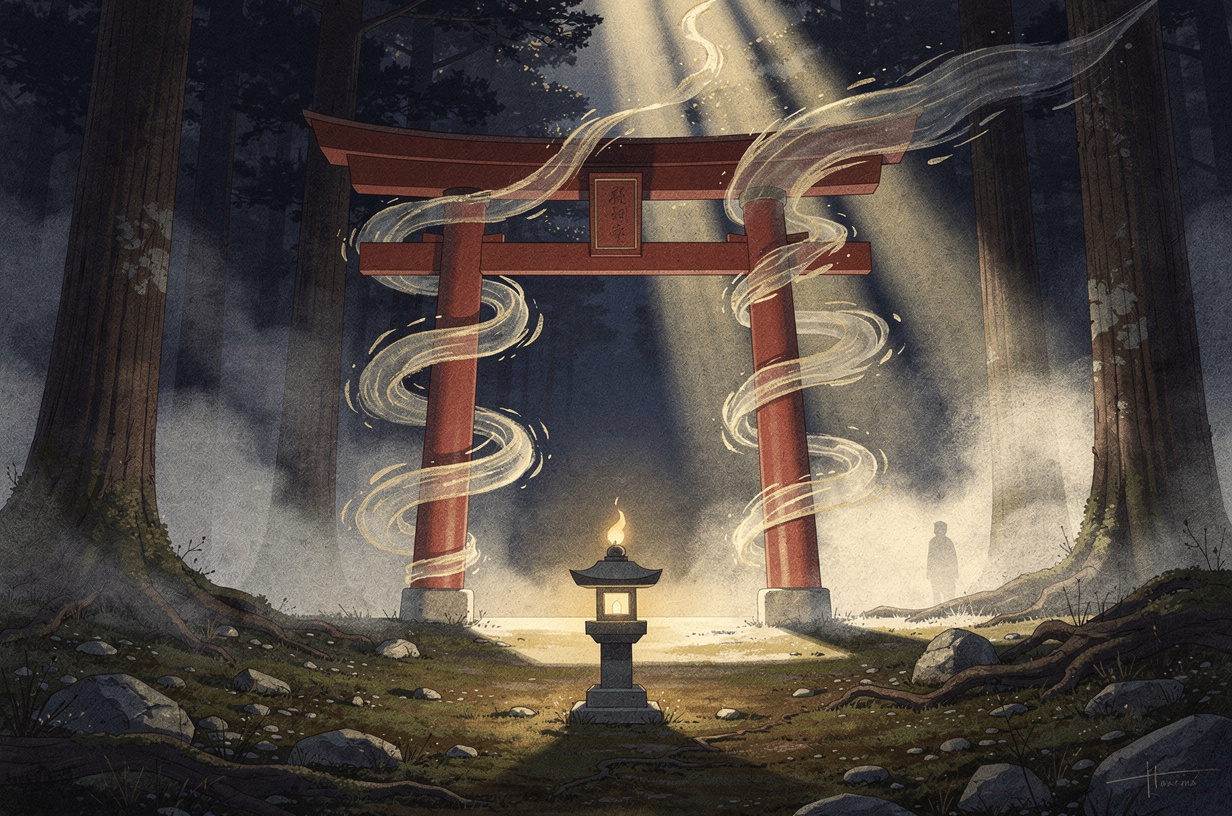
What unifies these vastly different spaces is a set of architectural features and spatial logics that communicate the same basic ideas about sacred presence and human approach. The torii gate — that iconic upright pair of posts with horizontal beams, typically painted red, though sometimes unpainted wood — marks the boundary between the ordinary world and the sacred space of the shrine precinct. Passing through a torii is understood as a transition, a movement from the profane to the sacred, and many practitioners pause and bow at the gate before entering. The pathway from the torii to the main hall, often lined with stone lanterns or flanked by ancient trees, is called the sandō, and its length and grandeur vary enormously. At the end of this approach stands the haiden, the hall of worship where worshippers gather and pray, and behind it the honden, the innermost sanctuary where the shintai — the sacred object understood to be the physical vessel or dwelling place of the kami — is enshrined. Ordinary worshippers do not enter the honden; in many cases, even most priests do not enter it. The kami's presence is held at the center, approached with reverence but not treated as accessible to casual contact.
The act of worship at a shrine is relatively simple in its external form, though practitioners understand it as laden with meaning. The standard sequence involves approaching the offertory box, tossing in a coin as an offering, bowing deeply twice, clapping one's hands twice to summon the kami's attention, and bowing once more. This practice, sometimes summarized as ni-rei, ni-hakushu, ichi-rei — two bows, two claps, one bow — has been standardized by shrine organizations in the modern period, though regional variations exist. Practitioners may also write wishes or prayers on wooden votive tablets called ema, which are hung at the shrine; receive paper fortunes called omikuji; or purchase amulets called o-mamori believed to carry the kami's protection for specific purposes — health, safe travel, academic success, good relationships.
Scholars note that the line between these practices as religious acts and as cultural customs is genuinely blurry for many Japanese people. Surveys consistently show that a majority of Japanese people do not identify as religiously Shinto in a self-conscious doctrinal sense, yet enormous numbers visit shrines — particularly at New Year, which sees the single largest concentration of shrine visits, called hatsumōde, when tens of millions of people make their first shrine visit of the year in the first days of January. This phenomenon prompts scholars to reflect on what it means to call Shinto a religion, a question to which we'll return.
---
The festival, or matsuri, is perhaps the most vivid and communally inclusive dimension of Shinto practice. Matsuri are held throughout the year at shrines across Japan, and their variety is extraordinary — some are ancient, solemn affairs involving elaborate court-style ritual; others are raucous, joyful celebrations with portable shrines called mikoshi carried through crowded streets on the shoulders of participants. What they share is the basic structure of welcoming the kami, hosting them in the human world for a period, celebrating with them, and then sending them back.
The mikoshi — a portable shrine, often ornate and gilded, carried by a team of participants who rock and jostle it as they process — is understood as the vehicle in which the kami travel through the community during a festival. The noise, the energy, the physical exertion of carrying the mikoshi are not incidental to the ritual; the rousing motion is understood as pleasing to the kami, as a kind of embodied welcome. Food offerings, music, dance — particularly the sacred dance called kagura performed by shrine maidens called miko — all form part of the matsuri experience. And the communal meal that often follows, in which participants eat food that has been offered to and blessed by the kami, creates a moment of genuine communion between the human and the divine.
Scholars who study matsuri emphasize their role in maintaining community cohesion. Organizing and executing a matsuri requires coordination, cooperation, and financial contribution from neighborhood associations. It marks time, renews bonds, and gives participants a shared sense of identity rooted in relationship with a particular kami and a particular place. This local, place-based quality of Shinto practice is one of its most distinctive features — the kami of a particular mountain or river or neighborhood is that community's kami, and tending the relationship with that kami is a collective, not merely individual, responsibility.
---
The question of Shinto's relationship with Buddhism is one of the most important and complex threads in understanding how the tradition has developed over the centuries. When Buddhism arrived in Japan in the sixth century, it did not simply displace or erase existing religious practice. The two traditions coexisted, interacted, and interpenetrated in ways that created a remarkable syncretistic culture. Buddhist temples and Shinto shrines were frequently built in close proximity. Kami were sometimes interpreted as Buddhist deities or as beings who, like humans, were subject to the cycle of rebirth and could benefit from Buddhist rites. Buddhist monks performed rituals at Shinto sites, and kami were given Buddhist titles and iconography. This blended system, which scholars sometimes call shinbutsu-shūgō — the combination of kami and buddhas — became the dominant religious culture of Japan for over a millennium.
It was a formal and dramatic disruption of this long synthesis that marks one of the most consequential moments in Shinto's history. When the Meiji government came to power in 1868, it implemented a policy of separating kami and buddhas — shinbutsu bunri — ordering the disentanglement of Buddhist and Shinto elements at sacred sites, and in some cases resulting in the destruction of Buddhist structures that had been integral to those sites for centuries. The Meiji government then developed what scholars call State Shinto — a formalized, state-sponsored system in which Shinto was reorganized around reverence for the emperor, portrayed as a direct descendant of Amaterasu and therefore as a divine figure. Scholars are careful to note that State Shinto was in important ways a modern ideological construction rather than a simple continuation of ancient tradition. It harnessed and transformed elements of the tradition to serve nationalist and imperialist ends, and it did so with considerable violence to the diversity and local character of traditional Shinto practice.
After Japan's defeat in the Second World War, State Shinto was formally abolished by the Allied occupation authorities through a directive in 1945. The emperor publicly renounced his claim to divine status. Shrines were disestablished from state support and reconstituted as private religious organizations. The relationship between Shinto and Japanese national identity became, and remains, a contested and sensitive subject — a site where debates about the war, about nationalism, about the boundary between religion and culture, and about what it means to be Japanese are actively and sometimes bitterly contested.
---
It would be a serious mistake to speak of Shinto as a single, uniform tradition. The diversity within what we call Shinto is enormous, and scholars increasingly emphasize that the singular label obscures a genuine plurality of practices, organizations, and orientations.
The largest and most visible institutional presence in contemporary Shinto is the Association of Shinto Shrines, known in Japanese as Jinja Honcho, which was established in 1946 and today oversees the vast majority of shrines in Japan — roughly eighty thousand of them. Jinja Honcho provides training for priests, sets standards for ritual practice, publishes educational materials, and advocates for Shinto interests in public life. It represents what scholars sometimes call shrine Shinto — the mainstream, institutionally organized form of the tradition.
But alongside shrine Shinto sit numerous other varieties. Sectarian Shinto refers to a group of independent religious organizations that emerged in the nineteenth century, some drawing heavily on Shinto concepts and kami while incorporating distinct doctrines, ethical teachings, and community structures. Groups like Tenrikyo and Konkōkyō, which some scholars classify under this broader category while acknowledging their distinctiveness, have their own scriptures, founders, and theologies that set them apart from shrine Shinto in significant ways. Folk Shinto refers to the enormous range of popular practices, local customs, and everyday interactions with kami that exist outside formal institutional structures — the roadside stone deity wrapped in a bib, the rice field blessed before planting, the household kami shelf called the kamidana where daily offerings of water, salt, and rice are placed. And new religious movements that emerged in the nineteenth and twentieth centuries, some explicitly describing themselves as Shinto-derived, have added further layers to the tradition's internal diversity.
There is also significant debate about the place of Shinto elements in what is sometimes called Japanese folk religion more broadly — the undifferentiated popular practice that blends Shinto, Buddhist, Daoist, and other elements in ways that are not easily classified. When a Japanese family participates in a Shinto ceremony at a shrine for a new baby, celebrates the Buddhist Obon festival for the spirits of the dead in summer, and holds a Christian-style wedding ceremony — a pattern that is actually quite common in contemporary Japan — what tradition are they practicing? This question opens onto genuine debates about how religion functions in Japan, whether traditional Western categories of religion apply there at all, and what role inherited cultural practice plays in Japanese identity.
---
The concept of the kamidana, or kami shelf, is worth dwelling on for a moment, because it illustrates beautifully how Shinto functions as a dimension of everyday domestic life rather than solely a matter of formal shrine attendance. Many traditional Japanese households maintain a kamidana, a small wooden shelf mounted high on the wall of a main room, bearing a miniature shrine structure, an amulet from a significant shrine, and offerings of water, salt, rice, and sometimes sake, which are renewed daily. Each morning, the head of the household or another family member will bow, clap, and offer a brief prayer at the kamidana. Alongside or separately, many homes also maintain a butsudan, a Buddhist altar for honoring the spirits of deceased family members. The coexistence of these two domestic sacred spaces in a single home is, for many Japanese families, entirely unremarkable — it simply reflects the historical layering of religious influences that has shaped Japanese life.
The kami revered at a household kamidana often include the kami of the family's tutelary local shrine, the great kami Amaterasu, and sometimes other kami associated with specific blessings the family seeks. The practice is not about doctrinal belief so much as about maintaining relationships — acknowledging the presence of the sacred in and around the home, expressing gratitude, and asking for continued protection and blessing. This relational quality — Shinto as a set of relationships with kami rather than as a set of propositions to be believed — is something both practitioners and scholars frequently emphasize.
---
Contemporary Shinto navigates a complex set of challenges and negotiations. One of the most discussed is the question of politics and nationalism. The 1945 disestablishment of State Shinto did not settle, once and for all, the question of the relationship between Shinto and Japanese national identity. Debates continue about whether certain rituals performed by government officials at Yasukuni Shrine — which enshrines the spirits of Japan's war dead, including convicted war criminals — constitute a violation of the constitutional separation of religion and state. These debates are intensely contested in Japan and internationally, touching on questions of memory, responsibility, national identity, and the boundaries of religious freedom. Scholars of religion, legal scholars, and politicians hold a wide range of views, and the controversy shows no sign of resolution.
There are also vigorous discussions about the environment. Some scholars and practitioners have pointed to Shinto's deep orientation toward the sacredness of nature as a resource for environmental ethics and ecological consciousness. The concept of satoyama — the traditionally managed landscape at the interface of mountain forest and agricultural land, understood as a place of balance between human and natural worlds — resonates with Shinto ideas about living in harmony with kami of place. Shinto shrines have, in some cases, preserved old-growth forest within their precincts for centuries precisely because those groves are understood as the dwelling places of kami — the so-called chinju no mori, sacred forests of the tutelary kami. Some scholars and practitioners argue that these inherited orientations offer genuinely valuable resources for thinking about humanity's relationship to the natural world in an age of ecological crisis. Others caution against overly romanticizing or essentializing Shinto's relationship to nature, noting that the tradition's ecological record is as complex and historically variable as any other.
Gender and inclusivity present another area of contemporary discussion. Historically, certain Shinto shrines and sacred spaces were subject to restrictions on the participation of women, based on ideas about purity and kegare associated with menstruation. Some of these restrictions persisted well into the modern period — the summit of certain sacred mountains was long closed to women. Many of these restrictions have been lifted or are contested within the tradition today, but gender-related questions continue to be debated, as do questions about how Shinto institutions engage with LGBTQ+ communities and with Japan's increasingly diverse immigrant population.
There is also the ongoing question of Shinto beyond Japan. Overseas Japanese communities have established Shinto shrines in various parts of the world, from Hawaii to Brazil. And some non-Japanese people have developed serious interests in and affiliations with Shinto practice, raising questions — sometimes warmly welcomed, sometimes contested — about whether Shinto can or should extend beyond its Japanese cultural context. Some practitioners argue that Shinto's essential character is tied to the specific landscape, history, and people of Japan, and that something important is lost in translation. Others hold that the encounter with kami can occur anywhere, that the generative power of musubi is not confined to any particular geography, and that sincere practice is open to all.
---
How do scholars approach the study of Shinto? This is a question worth addressing directly, because the scholarly study of this tradition has its own complicated history that shapes how we understand it.
For much of the nineteenth and early twentieth centuries, Western scholars approached Shinto primarily through the lens of evolutionary or comparative religious frameworks that were themselves products of their own cultural biases — frameworks that tended to rank traditions as more or less developed, more or less rational, and that often placed "primitive" nature worship at the bottom of an imagined ladder. These approaches have been thoroughly critiqued and largely abandoned. Contemporary scholars of Japanese religion come from a wide range of disciplines — history, anthropology, sociology, religious studies, art history, folklore — and they bring a much more sophisticated and culturally respectful set of tools to the work.
One area of significant scholarly debate concerns the very concept of "Shinto" as a stable, bounded tradition. Some scholars, most notably the historian Kuroda Toshio in influential work published in the nineteen-eighties, argued that what we call Shinto as a self-conscious, independent religious system is in important ways a modern construction — that for most of Japanese history, the practices we now label Shinto were embedded in a broader, undifferentiated religious culture that was not sharply distinguished from Buddhism or other traditions. This argument has had a significant impact on the field, prompting careful rethinking of how the tradition's history is narrated and cautious attention to the danger of projecting modern categories back onto the past.
Other scholars have pushed back on aspects of this "invention of tradition" framework, arguing that while the systematization and institutionalization of Shinto is clearly modern in important respects, there are genuine continuities of practice, belief, and experience that connect contemporary Shinto to very old layers of Japanese religious life. The debate is ongoing and productive — it keeps scholars honest about their assumptions and attentive to the complexity of what they are studying.
Scholars also bring attention to the diversity of voices and perspectives within Shinto itself. For a long time, studies of the tradition tended to focus on elite textual and institutional sources — the Kojiki, the Nihon Shoki, the theology of Jinja Honcho, the practices of major shrines. More recent scholarship has paid increasing attention to regional diversity, to the practices of ordinary worshippers, to the experiences of women within the tradition including the important role of shrine maidens and female priests, and to the ways in which Shinto intersects with class, ethnicity, and politics.
One particularly interesting methodological question concerns insider and outsider perspectives. Some of the most important scholars of Shinto have themselves been practitioners or priests, bringing an insider's knowledge and commitment to their work. Others come to the tradition as outsiders — sometimes Japanese scholars who do not personally practice, sometimes non-Japanese scholars working across cultural and linguistic boundaries. Each position brings distinctive strengths and limitations, and the richest scholarship tends to take seriously both the perspective of adherents describing their own experience and the analytical frameworks that help us understand how those experiences are shaped by history, culture, and social context.
---
As we come toward the end of our time together, it seems right to step back and reflect on what makes Shinto so distinctive and so persistently interesting to those who study it.
Shinto invites us to imagine a world in which the sacred is not hidden behind a veil or located in a transcendent realm entirely separate from ordinary life, but present — actively, dynamically, generatively present — in the mountain visible from your window, in the river you cross on your way to work, in the ancient tree at the corner of the neighborhood, in the rice that sustains you, in the breath of your own body. It asks what it would mean to live with consistent awareness of and gratitude for that presence. It suggests that the right response to being alive in such a world is not withdrawal or austerity but joyful, sincere participation — matsuri, offering, community, celebration.
At the same time, Shinto is not simple or naive. Its history is entangled with imperial politics, with nationalism, with war, with the construction and reconstruction of Japanese identity across centuries of profound change. It has been wielded by states and resisted by communities. It has been exported and adapted and translated and misunderstood. It contains within itself genuine diversity and genuine tensions — between local and national, between traditional and modern, between insider and outsider, between the living and the dead.
Whether one understands it as a religion in the conventional sense, as a cultural heritage, as a philosophical orientation toward the natural world, or as some irreducible combination of all of these things, Shinto represents a genuine and distinctive way of being human in the world — one that has shaped the lives of millions of people across many centuries and continues to do so today. To encounter it with genuine curiosity and respect, as we've tried to do here, is to expand one's sense of what the category of the sacred can mean and how many different forms the human longing to live well in a world suffused with meaning can take.
Thank you for listening to Intellegix World Religions. If you found this episode valuable, please share it with someone who might appreciate it, and leave us a review — it genuinely helps more curious minds find our work. We'll be back soon with another exploration of the traditions, practices, and beliefs that human beings have used to make sense of their lives and their world.