Missiles Over Kyiv, Markets on Edge: A World in Simultaneous Crisis
Within hours of U.S. envoys departing peace talks, Russia launched ballistic missiles and drones at Kyiv, killing two civilians — a sequence that crystallized a day defined by diplomatic failure, regional conflict, and deepening economic fractures.
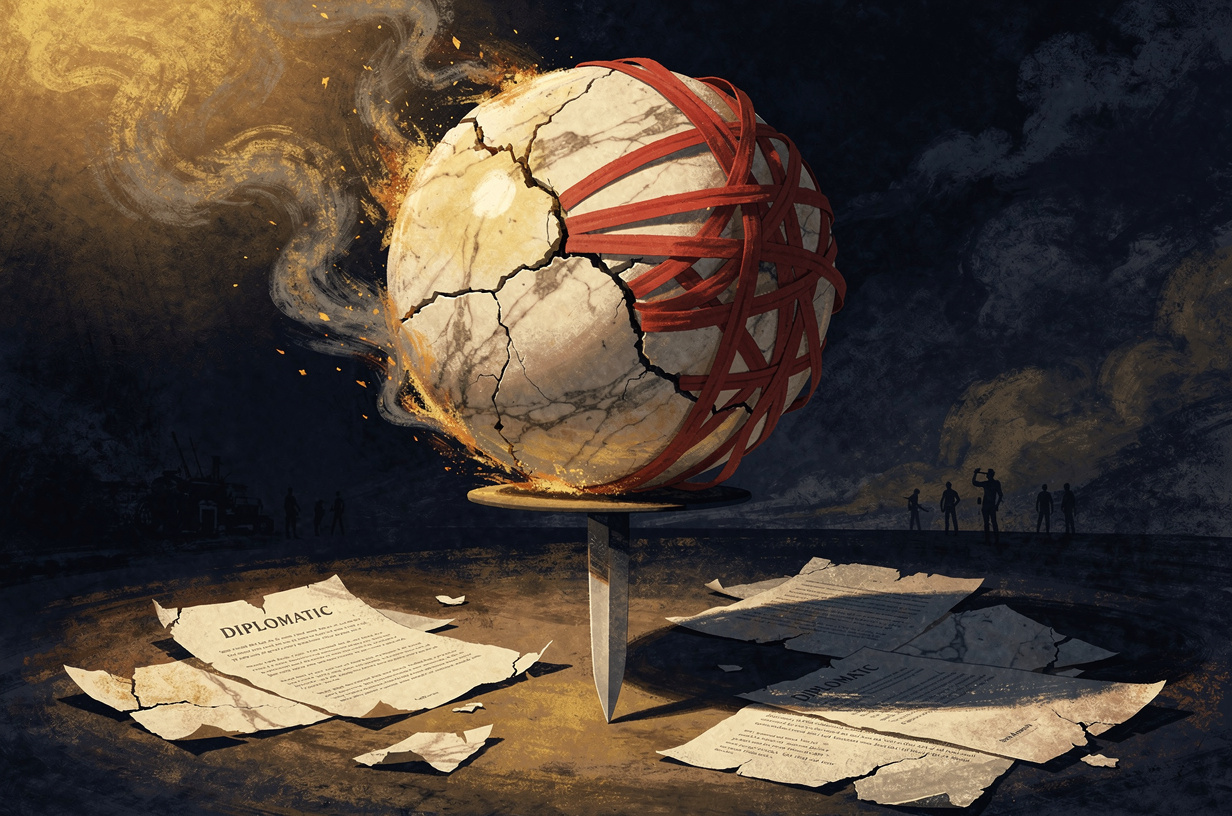
“The entire sanctions architecture the United States has constructed against Tehran depends on allies not quietly undermining it.”
How this was made Verified AI
Every Intellegix briefing is generated from that day's broadcast and run through automated checks before it publishes — with a human paged on any flag. Here is the trail for this edition.
Diplomats Depart, Missiles Arrive: Ukraine's Ceasefire Collapses
The pattern has now repeated itself multiple times in the Russia-Ukraine war: a temporary pause is declared, diplomats arrive with fanfare, talks produce no binding agreement, and the bombs resume — sometimes within hours. That is precisely what happened Monday night. A three-day truce expired, Russia launched ballistic missiles and drones at Kyiv, and two civilians were killed. U.S. envoys Steve Witkoff and Jared Kushner had been in the room with both Vladimir Putin and Volodymyr Zelenskyy — a remarkable feat of access — but the outcome was not remarkable at all.
The speed of Russia's resumption of strikes points to one of two interpretations: Moscow had the attacks pre-planned and staged the ceasefire as a tactical pause for repositioning, or the talks collapsed badly enough that Russia felt no diplomatic reason to hold fire even briefly. Neither reading is encouraging for the Trump administration, which has staked the personal credibility of Kushner, Witkoff, and the president himself on brokering a deal that the Biden administration could not. The current tally is multiple temporary pauses, no framework agreement, and continued civilian casualties in Kyiv.
Ukraine is not sitting passively on defense. Ukrainian drones struck the Saratov oil refinery inside Russia, injuring ten people. Saratov sits roughly 900 kilometers from the Ukrainian border in Russia's Volga region — a strike that disrupts Russian fuel supply chains, demonstrates to Moscow that the costs of continued aggression are not confined to Ukrainian territory, and signals to Zelenskyy's domestic audience that Ukraine retains meaningful offensive capability even while under pressure to negotiate.
The Saratov strike also complicates Putin's domestic narrative that this is a contained 'special military operation.' Explosions at a refinery in a major Russian city are not easily hidden from citizens living there. The energy dimension of the conflict runs in both directions — Ukrainian drones targeting Russian refineries while Russian missiles target Ukrainian power infrastructure — and the failed diplomacy this week ensures that exchange will continue.
Yemen, Gaza, Iran: Three Fronts Strain a Regional Order

The Middle East is demanding attention on at least three simultaneous vectors. Houthi forces struck targets linked to Saudi energy operations, wounding 73 people and forcing a halt at affected sites. The strikes reintroduce oil market risk at a moment when global energy markets are already unsettled by the Ukraine conflict — Saudi Aramco operations being disrupted, even temporarily, signals to futures traders that Persian Gulf infrastructure is less insulated from regional conflict than it might appear.
In Gaza, seven people were killed by Israeli strikes within a 24-hour window even as a ceasefire agreement nominally remains in place. The phrase 'ceasefire in name only' has been applied so frequently to this situation that it has almost lost meaning, but the operational reality is that strikes continue, casualties accumulate, and the diplomatic framework appears increasingly tenuous. The Trump administration inherited the ceasefire architecture that the Biden administration spent enormous political capital negotiating, and is now watching it fray without a clear strategy for reinforcement.
The Iran dimension connects all of it. The Trump administration has been conducting what senior officials describe as a pressure campaign against Iranian interests — military operations, sanctions, and interdictions — while both President Trump and Vice President Vance have conspicuously refused to use the word 'war' to describe the effort. That refusal is politically calculated: 'war' triggers specific constitutional questions about Congressional authorization, specific treaty obligations, and domestic political consequences the administration is evidently trying to avoid. Iran has now responded by formally labeling U.S. military pressure 'overt aggression' — a legally meaningful term in international law that signals Tehran is building a formal record for international and domestic consumption.
Senator Rick Scott further complicated the picture by declaring Turkey 'not our friend' after the U.S. Treasury Department sanctioned a Turkish bank for financial activity connected to Iran. Turkey is a NATO member. The comment reflects a genuine deterioration in the U.S.-Turkey relationship that has been building for years — and if Turkish banks are facilitating Iranian sanctions evasion, the problem is structural, not rhetorical. The entire sanctions architecture the United States has constructed against Tehran depends on allies not quietly undermining it.
Trump's Annexation Maps Draw Rare Bipartisan Rebuke

Over the Labor Day weekend, President Trump posted a map on Truth Social depicting Canada and Mexico as part of the United States, then followed up with seven separate posts pushing to rename the state of New Mexico 'New America.' The posts drew bipartisan criticism — genuinely noteworthy in a political environment where cross-party agreement involving Trump has become rare.
Two readings of the posts compete. The first frames them as pure domestic political theater: red meat for the base, projecting expansionism in a way that generates media attention and reinforces Trump's brand as someone who refuses conventional diplomatic constraints. Under this reading, Canada and Mexico issue careful statements and move on. The second reading is more operationally significant — that these posts function as deliberate pressure tools in ongoing trade and border negotiations, forcing Canadian and Mexican counterparts to spend political capital at home reassuring their publics that sovereignty isn't actually threatened, diverting diplomatic energy away from substantive negotiating positions.
The 'New America' rebranding push for New Mexico is particularly pointed because Trump has zero unilateral authority to rename a state — the posts are purely cultural assertion. New Mexico has a large Hispanic population with deep historical roots predating American statehood, and the name reflects that history. Pushing to erase it reads, to many residents, as an erasure of identity — which is presumably part of the political effect being sought.
The bipartisan condemnation raises a practical question: when Republican senators publicly distance themselves from a presidential social media post, it typically signals either that the content crossed a line allies find indefensible, or that specific constituent concerns — trade exposure, border economics, agriculture — make the post politically costly at home. With Wyoming ranchers simultaneously facing existential pressure from a 75-year-low cattle herd and competing import policy, that second factor appears highly plausible. What remains to be watched is whether any of this language shows up in actual trade negotiation postures, or whether Canadian or Mexican officials begin citing the posts in multilateral forums as evidence of American bad faith.
Tesla Under Federal Scrutiny, Huawei in Court, and Anthropic's Abandoned Billions
Tesla launched paid Cybercab rides in Austin — the first commercial deployment of a steering-wheel-free robotaxi at scale — and the National Highway Traffic Safety Administration opened a formal investigation into how the vehicle was certified as road-legal essentially before the rides had even begun. The NHTSA's central question is the right one: without a steering wheel, there is no human fallback, making this categorically different from Tesla's earlier Autopilot and Full Self-Driving deployments. The fact that regulators moved on day one suggests the agency had concerns before the launch.
The stakes extend far beyond Austin. Robotaxi revenue potential is the primary justification for Tesla's premium market multiple compared to traditional automakers. If the NHTSA probe results in operational restrictions, delayed expansion, or required hardware modifications, it threatens not just the Austin pilot but the entire investment thesis underlying Tesla's next decade.
In a Brooklyn federal courtroom, Huawei went to trial Tuesday on racketeering charges seven years after the U.S. government first filed against the company. The charges center on trade secret theft and sanctions evasion — specifically allegations that Huawei stole technology from American companies and used shell entities to continue operating in sanctioned markets including Iran. Applying RICO, originally designed to prosecute organized crime, argues that the individual violations were not isolated incidents but part of a systematic, organized pattern of behavior directed from the top — a considerably more aggressive legal posture than simple trade secret litigation. The trial arrives against the backdrop of a hardened U.S.-China technology competition, export controls on semiconductors, and ongoing debates about Chinese technology in American infrastructure.
Rounding out the corporate technology picture, Anthropic walked away from a deal to acquire Decart AI that would have been worth six billion dollars — the largest acquisition in Anthropic's history by a significant margin. Bloomberg reported that Anthropic conducted thorough due diligence before pulling out. When a buyer walks after deep review on a deal that size, the explanations generally fall into a few categories: valuation disagreement that couldn't be bridged, technical findings that didn't match the pitch, IP or legal concerns uncovered during review, or a strategic reassessment about direction. Decart AI had been positioning itself as a leader in real-time world models for AI — and for a company still burning capital as it scales, six billion dollars is not a casual decision to abandon.
America's Data Exposed: Smart TVs That Listen and 153 Million Stolen Licenses

An investigation has found that LG smart televisions actively log audio even when the set is in standby mode — a state most users assume means the device is essentially off — and scan the home networks they are connected to. The microphone remains active, collecting data without the kind of meaningful informed consent privacy advocates argue should be required. The network scanning component adds a further layer: the television is mapping what other devices are connected to a home's Wi-Fi, data that could be used to build detailed profiles of a household's technology ecosystem.
LG will likely argue that the behavior is disclosed somewhere in its terms of service, and technically may be correct. But the legal question and the ethical question are different. The legal question is whether a buried disclosure in a multi-thousand-word terms document constitutes adequate consent; the ethical question is whether a television manufacturer should be collecting this data at all. Consumer IoT devices — televisions, refrigerators, thermostats — operate in a substantially less regulated space than smartphones, and the LG finding will likely renew Congressional attention to a federal privacy framework that has stalled repeatedly over industry lobbying.
The IDScan breach represents a different category of failure — data collected for legitimate identity verification purposes exposed through a security failure. At least nine lawsuits have been filed after the breach compromised driver's license data belonging to 153 million Americans. For context, there are approximately 240 million licensed drivers in the United States, meaning the breach affected roughly 64 percent of them. The exposed data includes names, addresses, dates of birth, license numbers, and in many cases physical descriptions — everything needed for identity fraud, credential stuffing, or targeted phishing.
IDScan operates in the identity verification space, its systems used by businesses to verify age or identity at point of sale or online. The breach illustrates the concentration risk inherent in outsourcing identity verification to third-party vendors: each individual business that used IDScan likely had no idea its customers' data was aggregated into such a high-value target. Nine lawsuits filed in short order suggests plaintiff attorneys were prepared, with legal theories expected to focus on negligent data security, breach of contract, and potential violations of state-level privacy statutes including Illinois's BIPA and California's CCPA.
Wheat Spikes, China Surges, and AI Quietly Erases Finance Jobs

Chicago wheat futures posted their biggest single-day gain in nearly two weeks after U.S.-Russia diplomatic talks ended without progress on Black Sea grain access. The connection is direct: the Black Sea is the primary shipping corridor for Ukrainian and Russian grain exports to global markets. When diplomacy fails, traders price in continued disruption, and the effects flow through within hours to bread, pasta, and processed food costs, with the most acute impact felt in lower-income households and in countries that rely heavily on Black Sea grain imports across North Africa, the Middle East, and parts of Asia.
China's August export data delivered a striking counterpoint to narratives of successful western decoupling. Exports rose 25 percent year over year, and the trade surplus widened significantly — suggesting Chinese manufacturers are successfully redirecting trade flows despite U.S. tariffs and restrictions, finding markets in Southeast Asia, Africa, and Latin America that are absorbing Chinese goods. A wider surplus means more economic leverage, more capacity to absorb retaliatory tariff costs, and more domestic political ammunition for Xi Jinping to argue that the U.S. decoupling strategy is, at minimum, incomplete.
Wyoming ranchers are sounding alarms about Trump's 90-day beef tariff waiver allowing cheaper imports, against the backdrop of a U.S. cattle herd at a 75-year low — the smallest since the early 1950s. Rebuilding a cattle herd requires years of investment: retaining breeding stock, waiting for calves, growing those calves to market weight. The ranchers' argument is economically sound: why commit to long-term herd expansion while competing against lower-cost imports for 90 days, with uncertainty about what happens when the waiver expires? Short-term import relief may reduce consumer beef prices today while suppressing the domestic investment needed to grow supply over the medium term.
The finance and insurance sector shed 99,000 jobs in 2026, including 11,000 in August alone, even as the broader economy added 162,000 jobs in the same month. The sector-specific divergence is the key signal — this is not a recession story but a structural transformation, with AI automation eliminating specific categories of white-collar financial work faster than new roles are being created. S&P futures were trading down approximately 0.28 percent at 7,700 Tuesday morning, reflecting the accumulation of geopolitical risk across Ukraine, the Middle East, and the trade picture. The roles being lost — document processing, initial loan underwriting, basic claims assessment, fraud pattern detection — are tasks where AI does not merely assist a human worker but replaces the function entirely; the new roles AI might generate in finance tend to require different skills that displaced workers do not automatically possess.
Humanoid Robots, Starship's Rise, and a Sovereignty Dispute Over Drilling Rights
Unitree announced this week what it describes as the first autonomous humanoid robot powered by a real-time world model — a system that builds and continuously updates an internal model of its environment, allowing it to adapt to novel situations without prior training on that specific scenario. The distinction matters because the limitation of most current robotics is not processing power or motor control but the ability to handle unpredictability: a warehouse with fixed shelving is robotics-friendly; a construction site with shifting terrain and unstructured tasks is not. A genuine real-time world model would begin to address that gap, with substantial implications for physical labor automation. The claim will require independent technical scrutiny — 'world model' carries significant hype in AI research, and the gap between claim and verified performance has sometimes been wide — though Unitree has delivered functional humanoid products in its H1 and G1 models, so this is not purely a paper announcement.
SpaceX made a strategic infrastructure decision that signals where the company's priorities have shifted: it is ending all Falcon 9 Starlink launches from Florida to clear those launch facilities for Starship operations. Starlink has been SpaceX's reliable revenue engine, with hundreds of successful launches and a functioning satellite internet constellation. Subordinating those launches to Starship's development schedule reflects confidence that Starship's progress justifies the operational disruption. Falcon 9 can lift Starlink satellites efficiently, but Starship's payload capacity is on a different order of magnitude — and if SpaceX's vision of lunar logistics, Mars missions, and point-to-point Earth transportation is to be realized, Starship must become the operational backbone. Clearing Florida pad capacity is a concrete, effectively irreversible bet on that trajectory.
Argentina filed criminal charges against an Israeli oil firm for drilling near the Falkland Islands, which Argentina calls the Malvinas and considers sovereign territory. The 1982 Falklands conflict remains a defining national trauma, and successive Argentine governments have maintained the territorial claim even as the islands remain under British administration. The oil company presumably holds permits from British authorities who administer the islands, creating a jurisdictional conflict between two governments each claiming authority over the same geographic space — the kind of dispute that generates legal activity for decades without producing resolution. For the company, criminal charges in Argentina are a serious operational matter even where enforcement is practically difficult: international operations require banking relationships, insurance, and equipment suppliers, all of which can be complicated by outstanding criminal liability.
Hurricane Lowell's Fury and the Real Test of the AI Jobs Narrative

Hurricane Lowell struck Kauai with 30-foot surf and significant flooding — waves measuring from trough to crest at a height roughly equivalent to a three-story building, forcing evacuations and closures across the island's north shore. Pacific hurricane seasons typically curve systems away from Hawaii, but when one makes landfall, the topography creates extreme localized effects. Kauai's valleys channel rainfall into flash floods with very little warning, and the island's Na Pali Coast is particularly exposed to north and northwest swell. Hawaii has invested in early warning systems since the 2018 Kilauea eruption drew attention to emergency management infrastructure, but Lowell poses a different kind of threat — storm surge and surf rather than volcanic hazard.
The confident claim circulating in today's economic news — that AI automation is destroying finance and insurance jobs at an accelerating and irreversible rate — deserves pressure-testing. The finance sector shed 99,000 jobs in 2026, and AI is being treated as near-consensus cause by economists, labor researchers, and market analysts. But correlation is not causation. Interest rates shifted in 2026. Merger and acquisition activity fluctuated. Several large insurance carriers restructured. Regulatory changes reshaped mortgage origination volumes. After 2008, the finance sector shed enormous numbers of jobs and most analysts called it permanent structural change — and the sector did recover employment levels over the following decade, though with a different composition of roles. That historical record contains at least one major false positive on the 'structural, irreversible' call.
The strongest counterargument would hold that AI is a productivity tool rather than a job eliminator, and that firms are running leaner during an adjustment period while they figure out how to deploy AI effectively — with new financial products and regulatory compliance requirements eventually generating employment rebounds in different roles. That argument has partial force but runs against one key distinction: the roles currently being lost in finance — document processing, loan underwriting, claims assessment, fraud detection — are functions AI replaces entirely rather than merely assisting. The new roles AI might create in finance tend to require model governance, AI system auditing, and complex exception handling: different skills that displaced workers do not automatically possess.
The indicator that would reveal whether the consensus is wrong is visible in quarterly earnings reports from major banks and insurance carriers. If revenue per employee rises sharply even as headcount falls, AI is the productivity driver. If revenue per employee stays flat or declines alongside employment, the story is more complicated and may be cyclical rather than structural. If a new category of finance employment — AI auditors, model risk officers, compliance technologists — grows to replace what is lost, the outcome may be structural but not net-negative. The August jobs data is forcing these questions back onto the policy table, where retraining programs, wage support mechanisms, and regulatory guardrails on automation speed remain live debates without settled answers.