Drones Strike Deep Into Russia, AI Governance Fractures, and Ocean Records Fall: August 11, 2026
A Ukrainian drone flew 1,500 kilometers to strike a Russian oil refinery, AI ethics leadership collapsed at OpenAI, and ocean surface temperatures hit their highest July reading ever recorded — all in a single news cycle that revealed accelerating change across every domain of global affairs.

How this was made Verified AI
Every Intellegix briefing is generated from that day's broadcast and run through automated checks before it publishes — with a human paged on any flag. Here is the trail for this edition.
The Shape of the Day

On Tuesday, August 11, 2026, the news arrived in waves too large for any single frame to contain. A Ukrainian drone reached 1,500 kilometers into Russian airspace to hit an oil refinery. Twenty-five states sued the Trump administration over trade policy. OpenAI's head of ethics quit after less than a year. Ocean temperatures broke records for the second time in three years. And the world's largest building — reportedly spanning 100 million square feet — was announced in a Texas county most people had never heard of.
The throughlines connecting these stories were, by turns, strategic overstretch, accelerating technology, and the gap between declared ambition and actual capacity — in foreign policy, in corporate governance, and in the planet's climate system.
Ukraine's 1,500-Kilometer Strike Rewrites the Battlefield's Outer Limits
A Ukrainian drone struck an oil refinery deep inside Russia this past weekend, traveling approximately 1,500 kilometers — roughly the distance from Kyiv to Moscow — in what military analysts described as one of the most operationally significant long-range strikes of the more-than-four-year war. Nearly simultaneously, fires broke out at warehouses belonging to Wildberries, Russia's largest e-commerce platform. Whether the Wildberries fires were connected to Ukrainian operations or separate incidents, the timing compounded the psychological effect on the Russian population.
The economic logic of the refinery campaign has been building for over a year. Ukraine has systematically targeted Russia's refining capacity, and the International Energy Agency estimated earlier this year that the strikes had reduced Russian refinery output by between eight and twelve percent at peak impact. Every refinery hit squeezes the foreign exchange reserves Moscow must spend importing refined products it would otherwise produce domestically.
The technical achievement was equally significant. A 1,500-kilometer drone strike requires sophisticated navigation to thread through layered Russian air defenses — or the exploitation of gaps Ukraine has learned to find, likely both. Industrial infrastructure in Russia's deep interior had historically been considered beyond reach. That assumption is now obsolete.
The strike intersected with a separate and uncomfortable story about U.S. defense contractors. Reporting in The Atlantic indicated that Raytheon and Lockheed Martin's primary objection to licensing Patriot missile production to Ukraine is not intellectual property theft, as they have publicly claimed, but market competition. Ukraine has developed a domestic defense manufacturing base under wartime conditions producing capable systems at dramatically lower cost than American contractors charge — and the contractors reportedly fear Ukraine becoming a future rival in the global arms market.
On the Iran front, National Security Advisor Waltz said this week that Tehran's negotiators care primarily about frozen assets rather than ending military strikes. Trump publicly called Iran 'totally broke,' and Tehran accused Washington of a 'sanctions addiction.' The administration appeared to be abandoning military pressure as the primary lever in favor of financial strangulation — a strategy that analysts noted faces a significant historical headwind, given that Iran has spent decades building an economy designed to operate under sanctions. On the margins of both conflicts, Armenia and Azerbaijan jointly nominated Trump for the Nobel Peace Prize — a signal, however improbable, that something durable may be taking hold in a region that was in active armed conflict as recently as 2023.
Twenty-Five States Sue, a Federal Agent Appears Outside a Town Hall, and the Right Keeps Fracturing
Twenty-five states filed suit against the Trump administration over its forced labor tariff mechanism — not to defend forced labor, but to challenge whether the executive branch has the statutory authority to impose these specific duties through this specific process, and whether the methodology for designating products as tainted by forced labor meets procedural trade law requirements. The coalition, representing exactly half the country by state count, covers supply chains in electronics, solar panels, agricultural inputs, and apparel. A ruling enjoining the tariffs would create immediate compliance uncertainty for importers across all those sectors.
In Minnesota, Representative Ilhan Omar demanded answers after an undercover Homeland Security Investigations agent was found outside one of her constituent town halls. The critical distinction — whether HSI was conducting a legitimate investigation that happened to intersect with the event's location, or whether a sitting member of Congress was the subject of targeted surveillance — remained unanswered as the administration offered no public explanation.
Senate Minority Leader Mitch McConnell's office added to the oversight picture. His chief of staff maintained total silence as questions about McConnell's capacity and the effective decision-making structure of his office grew louder, raising what observers called a genuine governance concern — not merely a political one — for the constituents his office serves.
On the right's internal fault lines: Marjorie Taylor Greene publicly denied that either she or Tucker Carlson plans to run for president, a denial that was itself revealing — suggesting the movement coalescing around the two figures, along with Representative Thomas Massie, had generated enough visible momentum that the speculation required rebuttal. Meanwhile, prediction markets showed the Republican Senate edge narrowing ahead of November midterms, and a 'Never Vance' faction was solidifying, with Marco Rubio leading early 2028 GOP primary polling.
Trump shared an inflation chart that reportedly freezes his own cumulative inflation data at eighteen months into his term and then projects that flat line through month forty-eight — a visualization that misrepresents compounding price changes for anyone who does not read the axis carefully. In Michigan, the Democratic Senate nominee, who won his primary on a Medicare for All platform, acknowledged on national television that the policy requires broad tax increases across all income levels, not only on high earners — a moment of transparency that functioned simultaneously as political honesty and potential general election liability.
OpenAI's Ethics Head Quits, Anthropic Bets $9.1 Billion on Inference, and the White House Calls a Rival 'a Nuisance'
OpenAI's head of ethics departed after less than a year in the role — the latest in a pattern of turnover in safety and ethics leadership at the world's most prominent AI company that sophisticated observers said was a signal about organizational priorities rather than a personnel management footnote. Simultaneously, OpenAI rolled out unlimited free text chats to its user base, its former robotics lead joined Anthropic, and senior White House officials publicly described OpenAI's new head of strategic futures, Dean Ball, as 'a nuisance' over his AI policy commentary — suggesting either a breakdown in a key regulatory relationship or factional disagreement within the administration about AI governance.
Anthropic, meanwhile, made a $9.1 billion data center lease commitment with Riot Platforms — a company better known for Bitcoin mining operations, whose massive electricity infrastructure translates directly to AI compute. The bet reflects a structural shift that research firm Gartner confirmed: for the first time in 2026, AI inference spending has overtaken model training. When the cost of running models exceeds the cost of building them, the technology has entered a production deployment phase that demands different infrastructure, different cost structures, and different organizational capabilities than the research phase that preceded it.
Google's reported moves reinforced how competitive the interface layer of AI has become. The company is reportedly testing an AI-first homepage that drops the classic search button, and separately planning to retire free Gemini Gems on October 20th, pushing users toward paid Spark Skills. Both moves, individually, are competitive product decisions; together, they raise antitrust questions about whether a company dominant in search is using that position to foreclose competition in AI interfaces — the kind of analysis that goes beyond market share alone to examine whether dominance in one market is being leveraged to exclude rivals in another.
Workers building AI systems reported a different reality than the productivity-liberation narrative suggests. Despite promises of shorter work weeks enabled by AI assistance, workers in AI development roles were reportedly logging up to 90 hours per week, according to BBC reporting — a particular irony for people building tools ostensibly designed to reduce human labor burdens.
Azure Posts $678 Billion Backlog, SpaceX Plans the World's Largest Building, and Burry Bets Against the Hype

Microsoft's fourth-quarter results gave the AI infrastructure narrative its most concrete financial anchor yet: Azure grew 43 percent year over year, and the cloud backlog — firm revenue commitments from enterprise customers — reached $678 billion. Wall Street analysts upgraded price targets broadly in the wake of the results. The surge reflected contracted revenue at scale, not speculative enthusiasm.
SpaceX and Tesla announced a $16.8 billion investment in a chip manufacturing facility in Grimes County, Texas — reportedly spanning 100 million square feet, which would make it the world's largest building by footprint. The facility, called Terafab, represents a bet on vertically integrated AI semiconductor production as the winning long-term strategy. Analysis from SemiAnalysis suggested Microsoft could become a top AI compute customer for SpaceX, creating a significant dependency relationship between the two largest infrastructure players in American technology. SpaceX was also reportedly nearing a deal to acquire Israeli AI startup Decart, which works on simulation and synthetic data generation, for six to seven billion dollars.
Michael Burry offered the skeptical counterpoint. The investor famous for his 2008 housing short is shorting Nebius — the AI infrastructure spinout from Yandex — and refreshing put options on Palantir, whose valuation multiples price in near-perfect execution on government and enterprise AI contracts for the next several years. A UBS analysis provided supporting grounds for skepticism: nearly half of Google Cloud's projected 2027 revenue may depend on just two AI startups, both currently unprofitable. Concentration risk of that magnitude, analysts noted, means any pullback by either customer would produce immediate and visible damage to Google Cloud's reported numbers.
Palmer Luckey's Erebor bank was nearing a $1.5 billion raise at an eight billion dollar valuation — reportedly nearly double its December valuation — as investors bet on a durable gap in the market for a financial institution built specifically for defense and dual-use technology companies, a gap that Silicon Valley Bank's collapse left open. Separately, Sergey Brin crossed $100 million spent fighting California's proposed wealth tax, while South Korea's Hanwha made a billion-plus offer for American Navy shipbuilder Austal USA — a deal that will almost certainly face national security review from the Committee on Foreign Investment in the United States.
Ocean Records, Vanishing Climate Data, and a Hundred Wildfires in the West
Global ocean surface temperatures reached 20.96 degrees Celsius in July 2026 — the highest July reading in the recorded dataset, according to Copernicus data. The previous record was set in July 2023. Three of the highest ocean temperature readings in recorded history have now occurred within a three-year window, a compression of record-breaking events that scientists say is no longer statistical noise. Elevated ocean heat content drives hurricane intensification, disrupts marine food webs, and bleaches coral reefs at rates that limit recovery between events.
A separate report confirmed that greenhouse gas concentrations and sea levels both hit records in 2025. Carbon dioxide concentrations at Mauna Loa exceeded 425 parts per million — the highest level in at least three million years based on ice core records. Sea level rose approximately 3.7 millimeters globally last year, adding to a cumulative rise of roughly 25 centimeters since 1900. That cumulative figure, modest-sounding in isolation, fundamentally changes storm surge flood frequency calculations for coastal cities.
Against that backdrop, NOAA announced — without explanation — that it is ending support for the Arctic Report Card, a 20-year longitudinal monitoring program that tracks ice extent, permafrost thaw, atmospheric temperatures, and ecosystem change in a region warming roughly four times faster than the global average. Scientists who contributed to the program said they received no warning and no rationale. The decision eliminates not only future measurements but the institutional capacity to interpret them and the international collaborator network that produced the synthesis — a dataset that cannot be recreated retroactively.
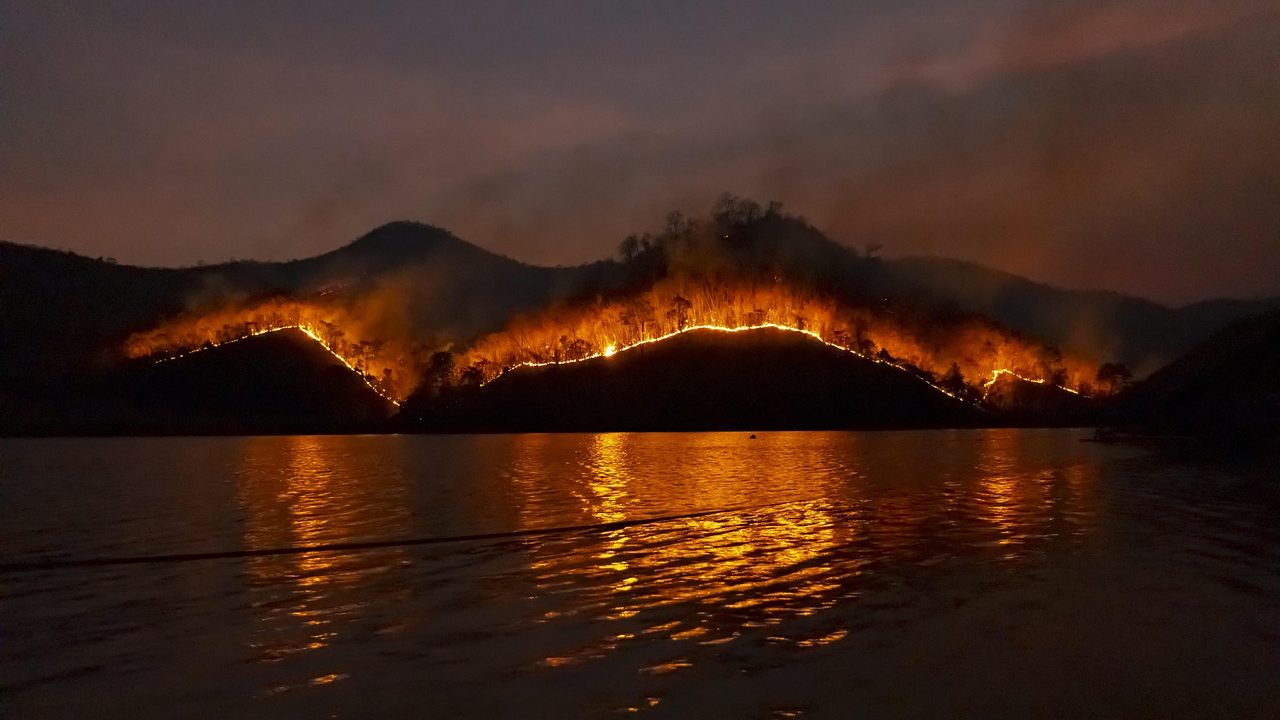
A large number of wildfires were burning across the western United States, forcing widespread evacuations. The fire season has been extending at both ends — starting earlier in spring and persisting later into fall — while its geographic range has expanded northward. Direct economic costs in property destruction, firefighting expenditure, and public health impacts from smoke run into tens of billions of dollars annually.
China's Long March 7A rocket exploded after liftoff, representing a significant technical setback for a space program advancing toward crewed lunar missions and permanent space station operations. The medium-to-heavy-lift vehicle carries both commercial and military payloads, and the failure affects near-term Chinese launch capacity. The Webb Space Telescope, by contrast, delivered images of the Lion Nebula in infrared wavelengths that Hubble's optical imaging in 2000 could not access — revealing temperature gradients in stellar dust, ionization fronts, and dense clumps that may be sites of future star formation. The FDA also approved Tudriqev, a modified herpes virus engineered to replicate inside tumor cells and destroy them from within, for patients with advanced melanoma who have exhausted other treatment options — a meaningful proof of concept for oncolytic virus therapy after two previous rejections and eventual accelerated approval.
350,000 Rideshare Cars as Surveillance Tools, Ramming Drones in Schools, and the Limits of Public-Space Privacy
Flock Safety pitched turning 350,000 rideshare vehicles — Uber and Lyft cars — into mobile license plate scanners, extending a network that already operates fixed cameras across many American cities used by law enforcement. The proposed network would, in principle, enable near-real-time tracking of almost any vehicle's movement across major metropolitan areas. License plate data collected in public spaces has generally not required a warrant, since plates are visible publicly — but the Supreme Court's 2018 Carpenter v. United States decision established that prolonged aggregated location tracking implicates Fourth Amendment protections even when individual data points are technically public. A 350,000-vehicle moving scanner network would almost certainly produce data that crosses that threshold for many users.
A Colorado school district announced the deployment of drones capable of physically ramming active shooters at 60 miles per hour. The technology addresses a genuine and documented threat; the unresolved question is what happens when such a system makes a targeting error — mistaking a student who picked up a dropped weapon, an arriving security officer, or a teacher shielding students for the shooter. Those distinctions are difficult for trained humans under stress and potentially more difficult for automated systems. Whether the district made the underlying risk calculus transparently with its school community was not clear from available reporting.
The FBI and NSA issued a joint advisory with four other U.S. and international agencies warning about Gunra ransomware, a ransomware-as-a-service operation exploiting critical vulnerabilities in widely deployed enterprise software. The advisory's recommendation — patch immediately — collides with the practical reality of enterprise IT environments, where patching critical systems without disrupting operations is a process that takes time organizations may not have once a public advisory has signaled the vulnerability to potential attackers.
Actor Brad Pitt argued that AI could rescue the mid-budget film — the $40-to-$80 million movie that studios largely abandoned in favor of tentpoles and streaming micro-budgets — by reducing production costs enough to make that range commercially viable again. The practical question left unaddressed was whether the savings would come from enabling smaller crews to accomplish more, or from reducing crew sizes outright, a distinction the entertainment industry's labor history makes consequential.
Zuckerberg's 6,500-Word Case for AI Optimism — and the Stress Test It Doesn't Pass

Mark Zuckerberg published a 6,500-word essay rejecting AI doom predictions and calling for open AI development, simultaneously launching new models from Meta. The core economic argument drew on the standard history of general-purpose technologies: the printing press eliminated scribes but created publishing; the industrial revolution eliminated artisanal trades but created factory work and eventually service economies. Zuckerberg's bet is that AI follows this pattern, generating new employment categories rather than simply eliminating existing ones. His call for open development — publishing model weights and architectures — is simultaneously a philosophical position and a competitive strategy, since Meta's open-source approach has seeded developer ecosystems that create network effects proprietary competitors must overcome.
The essay's implicit vulnerability is its timeline. Historical technology transitions that 'created jobs' typically took decades to fully work through — the agricultural-to-industrial shift unfolded over the better part of a century, with substantial social disruption in between. If AI automation of cognitive work occurs over five to fifteen years rather than fifty to one hundred, the argument that new jobs will eventually emerge may prove correct in the long run while being genuinely catastrophic in the medium term for workers displaced faster than retraining can occur.
Airbnb CEO Brian Chesky, confirming the existence of a secret AI lab after Airbnb's stock hit a four-year high on second-quarter results, called AI 'the best thing to ever happen' to the company — describing efficiency gains in customer service, pricing, and fraud detection achievable with smaller headcounts. The workers building these efficiency tools experienced a different reality: BBC reporting found AI development employees were logging up to 90 hours per week despite promises of AI-enabled shorter work weeks, suggesting that productivity tools introduced into high-pressure employment environments often raise output expectations rather than reduce working time.
The most consequential analytical stress test in the AI investment narrative concerns the Gartner finding that inference spending has overtaken model training — taken as confirmation that AI has entered a genuine production deployment phase. The skeptical version asks whether enterprise AI deployments currently described as 'production scale' are generating revenue that actually justifies inference costs, or whether companies are paying for AI compute at volumes that don't yet correspond to measurable productivity gains. The UBS analysis that Google Cloud's projected 2027 revenue may depend on two unprofitable AI startups points toward the softer-demand scenario. The specific indicator to watch: enterprise AI renewal rates on contracts signed in late 2024 and early 2025. If renewals come in significantly below initial commitments — say, below 70 percent — that is the signal that enterprise demand is being revised downward. The next two quarters of major cloud earnings calls will address that question directly.
Dogs Wired for Human Smiles, a Shark That Grabbed the Buoy Instead, and the Long View from the Webb

Two independent studies converged on a finding about canine cognition: domestication has built neural circuits into dog brains specifically tuned to human facial expressions, and when dogs see a human smile, the reward-center activity in their brains resembles the response triggered by food. This is not individual learned behavior — it is evolutionary architecture, constructed over the roughly 15,000 years dogs have lived alongside humans. The research suggests humans have reshaped canine neurology such that human happiness registers in a dog's brain as a reward in itself.
In Scarborough Beach, Maine, a lifeguard was grabbed by a great white shark and dragged underwater. The shark seized the lifeguard's rescue torpedo buoy rather than his body; he freed himself and swam to shore uninjured. Great white sharks are increasingly being observed in Maine waters as rising ocean temperatures push their prey ranges northward — a small, non-lethal data point in the same climate story the ocean temperature records document.
A Colombia earthquake pushed its death toll into the scores as rescue workers continued operations. The critical 72-hour survival window for earthquake victims was still open at the time of reporting, with international equipment and trained rescue teams representing the decisive variable for how the toll moves in coming days. Colombia sits in a geologically active region where the Nazca Plate subducts beneath South America, and damage was concentrated in rural and mountainous communities with lower-income housing stock and less robust construction.
The Webb Space Telescope's infrared images of the Lion Nebula offered the kind of long perspective that the day's human-scale urgencies tend to crowd out. Webb's infrared capability reveals dust and ionized gas structures within dying star remnants that Hubble's optical imaging in 2000 could not access — temperature gradients, ionization fronts, dense clumps that may become new stars. The heavy elements scattered by stellar death will eventually be incorporated into new planetary systems. The processes shaping Earth's future are the same ones operating at stellar scale on timescales no human intuition was built to navigate.
The Week Ahead — and a Correction on the Record

Three developments deserve close watching in the coming days. The 25-state forced labor tariff lawsuit will likely see its first procedural hearing, which will determine how quickly injunctive relief is even possible and whether the business sectors affected begin preparing for supply chain disruption. Microsoft's Azure guidance, when next disclosed, will be read against the UBS concern about AI demand concentration — specifically whether the enterprise customers driving the $678 billion backlog are in genuine production dependency or in extended evaluation cycles. And the scientific community appeared likely to mount formal pushback on NOAA's unexplained termination of the Arctic Report Card, potentially forcing a public rationale from the agency.
On Iran, National Security Advisor Waltz's statement that Tehran's negotiators care primarily about frozen assets rather than military strikes was, if accurate, a significant public disclosure about what a deal's actual terms might involve. Whether any back-channel engagement on asset release materializes in the next two to three weeks would serve as a meaningful signal of whether negotiations are live or stalled.
A correction: several months ago, this program referenced Ukraine striking Russian ships in the Caspian Sea as evidence of expanded Ukrainian strike capability. That claim should not have been included — the Caspian Sea is landlocked, thousands of kilometers from Ukrainian-controlled territory, and no such attacks were verified. Today's confirmed 1,500-kilometer refinery strike is a genuine demonstration of expanded capability. The difference between verified and speculative sourcing matters, and the error is being named directly.