From a One-Vote Attorney General to AI's $745 Billion Question: August 8, 2026 Briefing
A razor-thin Senate confirmation installed Trump's former personal defense attorney as the nation's top law enforcement officer, while strategists, financiers, and Pentagon generals each signaled, in their own ways, that the institutions around them are under unusual strain.
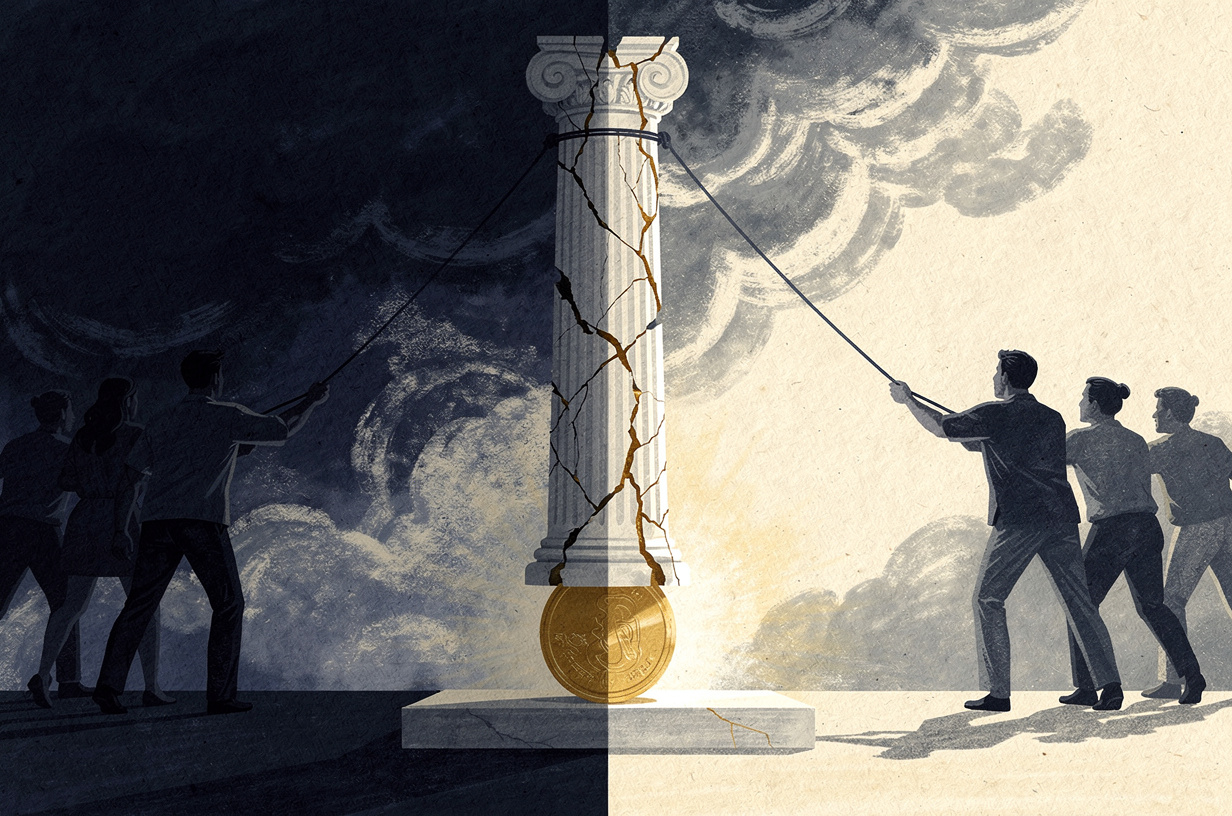
“When incumbents lose primaries in redrawn districts, voters are typically expressing dissatisfaction with the party establishment through the one channel where they retain leverage.”
How this was made Verified AI
Every Intellegix briefing is generated from that day's broadcast and run through automated checks before it publishes — with a human paged on any flag. Here is the trail for this edition.
One Vote, One Attorney General, and All the Questions That Follow
The Senate confirmed Todd Blanche as Attorney General by a vote of fifty to forty-nine — one of the tightest cabinet confirmations in recent memory and, by itself, a measure of how contested the nomination was. Blanche is not an obscure Washington functionary. He served as Donald Trump's personal criminal defense attorney, sitting at the table during both the New York hush money trial and the federal classified documents case. Nominating that same attorney to lead the Justice Department raised immediate conflict-of-interest questions that even some Republican senators could not easily dismiss.
The concessions required to secure confirmation were substantial. Blanche rescinded a controversial $1.8 billion anti-weaponization fund — a proposal critics characterized as a mechanism for funding investigations into the administration's political opponents — and agreed to narrow what was described as a tax-immunity deal. When a nominee surrenders those items before a single vote is cast, it suggests the opposition had enough credibility to matter. The central question now is whether concessions made to court undecided senators survive contact with the office itself.
The Justice Department is already navigating legally sensitive terrain. The department has declined to refund restitution payments made by a pardoned January 6th rioter, threading a needle between honoring the pardon politically and maintaining that financial obligations to victims constitute a separate matter. Separately, the Senate Homeland Security Committee voted eight to five along party lines to hold former NIAID director Anthony Fauci, age eighty-five, in contempt for invoking the Fifth Amendment. The DOJ is now reviewing that referral, though legal experts across the spectrum have expressed skepticism about prosecution viability — invoking a constitutional right is, in itself, constitutionally protected conduct.
What connects these early episodes — Blanche's confirmation, the restitution position, the Fauci referral — is the department being asked to serve the administration's political objectives while maintaining credible standing in federal courts. Legal observers note those two demands are not always compatible. A fifty-to-forty-nine confirmation suggests even Blanche's own party is not fully persuaded he can walk that line.
Ceasefire Talks, Cyberwar, and the General Seeking an Exit

The U.S.-Iran conflict has expanded into what strategists have warned about for years: active hostilities targeting civilian infrastructure. Attacks described as hitting data centers, power plants, and water systems move the conflict well beyond military-to-military engagement. Striking a water system targets civilian populations in ways that are both strategically potent and deeply destabilizing, eroding a government's core claim of competence to its own people.
Iranian President Pezeshkian publicly claimed that citizens 'didn't feel the war,' crediting coordinated governance and regional cooperation for shielding daily life. Two readings compete: that Iranian civil resilience and dispersed infrastructure genuinely absorbed the strikes better than anticipated, or that a president is engaged in domestic political management while his country absorbs significant infrastructure damage. The gap between that public posture and the reality of cyberattacks on water systems is a gap worth watching.
Treasury Secretary Scott Bessent said on Friday that a thirty-to-sixty day ceasefire agreement to reopen the Strait of Hormuz is close — potentially as soon as Saturday — but that Iran is pushing back on new sanctions being layered into any deal. The impasse is fundamental: from Tehran's perspective, agreeing to a halt while accepting additional sanctions means losing twice. Bessent's public optimism may reflect genuine progress or may constitute pressure tactics, since announcing a deal could come 'today' sometimes moves the other side's timeline.
The most consequential domestic signal came from within the Pentagon itself. A top U.S. general has been privately pushing for an off-ramp from the Iran conflict — and the fact that such a position has reached public reporting suggests a level of institutional concern about escalation paths. Meanwhile, Congress moved in the opposite direction, passing a sanctions bill targeting both Russia and Iran, named for the late Senator Lindsey Graham. The executive branch and military appear to want an exit; Congress wants more pressure. That tension between branches — and between civilian and military leadership — is where the story actually lives.
On the Russia-Ukraine front, President Zelenskyy traveled to Serbia for diplomatic talks even as fresh Russian missiles struck Kyiv. Serbia, which has maintained historically close ties to Moscow and resisted full alignment with Western sanctions, is a deliberate venue choice. Zelenskyy's visit to Belgrade signals an effort to peel away the remaining pockets of Russian diplomatic cover in Eastern Europe. The strikes on Kyiv while talks proceeded elsewhere reflect Russia's standard approach: military pressure deployed as diplomatic punctuation.
Republicans, Redistricting, and a Democrat Leading in Texas

Several domestic political developments this week form a coherent narrative about where both parties stand heading into the 2026 midterm cycle. In an interview with Punchbowl News, Trump said voters are 'angry at Republicans, not me' — a remarkable statement for a sitting president to make about his own party. It is a distancing maneuver consistent with his pattern of separating his personal political fortunes from the broader GOP brand whenever polls turn negative.
The polling context gives the comment added significance. Democrats are leading on the generic congressional ballot. A Democrat is ahead in the Texas Senate race — a result that would have been nearly unthinkable two election cycles ago. And Tennessee's newly redistricted map produced real upsets in its first primary test, demonstrating that redrawn districts do not always deliver the outcomes mapmakers intended. When incumbents lose primaries in redrawn districts, voters are typically expressing dissatisfaction with the party establishment through the one channel where they retain leverage.
Trump's comment that he could probably 'get along' with Hakeem Jeffries as House Speaker also drew attention, suggesting he is already gaming out scenarios where Republicans do not hold the House after November, or where Democratic votes are needed to move his legislative agenda. Separately, he said it is 'way too early' to endorse Vice President Vance for 2028 after private donor remarks surfaced — a signal that loyalty flows from Trump only as long as it serves him, creating uncertainty for those around him.
On the Democratic side, Kamala Harris delivered a keynote in New Orleans explicitly calling on Democrats to show 'ruthlessness.' The word choice is deliberate. Democrats have been criticized internally for what some describe as a defensive, proceduralist political style. Whether that rhetorical shift translates into a genuine change in party strategy and infrastructure is a separate question, but the signal to the base is unmistakable. A new ICE policy explicitly allowing the agency to withhold body camera footage it deems unfavorable, combined with the White House using an AI-generated Spider-Man image captioned 'Your friendly neighborhood ICE agents,' prompted scrutiny from both transparency advocates and, reportedly, Marvel and Sony's legal teams over unauthorized likeness use.
The $745 Billion AI Bet With No Clear Business Model

NYU professor Aswath Damodaran — whose valuation frameworks are used in business schools on every continent and who is sometimes called the Dean of Valuation — published analysis this week warning that Microsoft, Amazon, Meta, and Alphabet combined could spend $745 billion on artificial intelligence this year without a defined path to returns. That is not a marginal concern from a peripheral skeptic. Damodaran has spent decades valuing companies across sectors, and when he says he cannot find the business model, the warning carries institutional weight.
Bank of America is flagging AI valuations as approaching dot-com era extremes. Their specific data point is striking: all six Magnificent Seven stocks that reported earnings last week saw price swings exceeding what options markets had priced in — and this was apparently the first time that has occurred across all six in the same week during the ChatGPT era. The options market is conventionally regarded as sophisticated on volatility expectations. When reality consistently exceeds those expectations, either the market is structurally mispriced or something about AI earnings is fundamentally harder to model than previously assumed.
Nvidia is not waiting for that debate to resolve. The chipmaker committed up to $3 billion to Lancium and joined a $2 billion capital raise for Firmus this week, deepening its stake in physical AI infrastructure. Whether or not AI software business models ultimately pencil out, the infrastructure buildout generates real spending that flows through Nvidia's order books. The company appears to be constructing a vertically integrated position — selling chips, helping build the facilities that house them, and holding equity in the companies that own those facilities.
A stark data point frames the gap between ambition and execution: only twenty percent of planned U.S. AI data centers are actually under construction. Some of that gap reflects genuine bottlenecks in permitting and grid connection queues. But some of it also depends on revenue projections that have not yet materialized. Amazon is reportedly building a $2 billion data center in Gilroy, California, without residents' knowledge — the secrecy is the story, but the underlying fact is that the buildout continues at a pace that outstrips public awareness.
HR and finance software company Rippling reportedly burned through millions in unchecked AI token costs before launching what it is now calling an AI Spend Console — a dashboard for enterprises to track and control AI spending. The fact that a sophisticated technology company with experienced engineers and finance systems ran up millions in unintended AI costs is a micro-illustration of what Damodaran is describing at the macro level. The companies now selling cost-management tools for AI spending are themselves a new industry created by the inefficiency of the AI industry — a feedback loop worth monitoring.
Sodium Versus Solid-State: The Battery Race Shaping the Next Decade

Amazon's decision to back a 7.65-gigawatt natural gas power plant in West Texas — which would be the largest single planned gas facility in the United States and potentially the nation's biggest single pollution source — is a direct consequence of AI data center load curves that do not dispatch well from wind and solar alone. Amazon looked at that math and chose gas turbines for an off-grid AI campus. AWS simultaneously told its own engineers to cut CPU waste because AI demand is straining existing capacity, confirming internally what the external investment signals: the company is running hot across its infrastructure stack.
The battery landscape tells a competitive story unfolding on two distinct chemistry tracks. U.S. startups are beginning to deliver sodium-ion batteries — cells built on sodium, essentially table salt chemistry, rather than lithium. The strategic logic is clear: sodium is globally abundant, reducing dependence on Chinese lithium processing and creating a supply chain that does not route through Beijing. The Defense Department committed $2 billion this week to accelerate domestic alternatives, including a $1.4 billion loan to Sila Nanotechnologies, alongside additional deals at a mining roundtable.
BYD filed six solid-state battery patents this week with an eye on pilot production in 2027. Solid-state batteries offer higher energy density and better safety than conventional lithium-ion cells. Six patents filed in a single week signals a serious patent-staking phase ahead of commercialization. The United States and China are both accelerating — but on different chemistry paths. Sodium-ion versus solid-state lithium is not merely a technical debate; it is a proxy for which supply chain architecture governs the next decade of energy storage.
The consolidation pace in both battery and AI infrastructure sectors raises antitrust questions that will shape what mergers and vertical integration are legally permissible. The Sherman Antitrust Act of 1890 prohibits monopolization and attempts to monopolize markets, but dominant market share alone is not illegal — the law requires showing that dominance was acquired or maintained through exclusionary conduct rather than superior products or legitimate competition. Nvidia's simultaneous ownership of chips, facilities, and equity in the companies running those facilities creates vertical integration the Department of Justice will need to assess under exactly that framework.
Alphabet's $28 Billion SpaceX Hit, Bitcoin's Mixed Week, and a Booster Lost at Sea
S&P futures were up roughly forty-five points Saturday morning near 7,780 — a modest gain capping a week of significant individual stock volatility. The most dramatic single-stock event was Alphabet's SpaceX stake losing $28 billion in value as the lockup period expired and early investors were finally free to sell. Markets often price in anticipated selling pressure before a lockup expiry, but a $28 billion erosion suggests the supply of shares hitting the market exceeded what buyers were prepared to absorb at existing prices. SpaceX stock surged on Friday, snapping its losing streak, suggesting the wave of selling pressure may have cleared.
The lockup expiry arrives as Tesla-SpaceX merger speculation is intensifying. The argument for combining them centers on Musk-simplification: one publicly traded entity, shared infrastructure, and a cleaner capital structure. Skeptics warn that Tesla shareholders would be absorbing SpaceX's government contract risk and regulatory complexity in a transaction that almost certainly favors SpaceX's private shareholders. The Cursor AI coding assistant — which reportedly reached a deal within SpaceX's orbit — is having its brand retired as it is folded into a larger entity, a development that matters in the developer tools market because Cursor built a meaningful identity among professional engineers.
On cryptocurrency, Trump told an audience in Las Vegas on Wednesday that Bitcoin 'takes pressure off the U.S. dollar' — framing crypto adoption as complementary rather than competitive with dollar reserve status. The political signal to the crypto community is clear even if the policy substance remains thin. The harsher reality arrived via a BTCPay Server exploit that drained Lightning Network wallets amid what is being called Coldcard fallout, Coldcard being a popular hardware wallet manufacturer. When payment infrastructure is exploited, merchants lose real funds — the Lightning Network's security model requires users to be online monitoring their channels, a vulnerability that does not exist in traditional payment rails.
Musk said this week that recovery of the Starship booster that has been floating at sea for two weeks is 'not looking good.' Starship's development model has always emphasized rapid iteration through failure, but a booster that cannot be retrieved after two-plus weeks at sea raises questions about the economics of the reusability model that underpins the entire Starship business case. Meanwhile, Leopold Aschenbrenner — the former OpenAI researcher who founded Situational Awareness — bet $400 million on a chip startup days after what was described as a public blowup, a statement that the compute buildout is real regardless of unresolved software business model questions.
Voyager's Software Patch, Darwin Vindicated, and Lake Mead's Record Low
NASA engineers extended Voyager 2's mission by at least a year through a software patch that redistributed power usage — a repair executed on a spacecraft that has been in space since 1977 and is now more than nineteen billion kilometers from Earth. Each communication requires roughly seventeen hours of light-travel time each way, making the round-trip delay approximately thirty-four hours. The engineering challenge of remotely patching software on a near-fifty-year-old spacecraft at the edge of the solar system, under those communication constraints, is difficult to overstate.
MIT physicists used ultrafast laser experiments this week to capture two coexisting electronic phases in a quantum material simultaneously, in real time, observing how those phases rebuild through fundamentally different mechanisms after disruption by a laser pulse. The finding that quantum materials can exist in multiple phases at once — competing or coexisting depending on conditions — is the basic science underlying quantum computing hardware and next-generation superconductors. Understanding how those phases rebuild dynamically is the kind of foundational knowledge that eventually shows up in actual devices.
A 150-year wait ended in Nature Communications this week. Charles Darwin observed a Saxifraga plant species in 1875 and theorized it was digesting insects. Researchers confirmed that the plant does trap, digest, and absorb nutrients from insects — passive carnivory without the active trapping mechanisms of a Venus flytrap, which made experimental confirmation subtler and slower to achieve. Darwin's observational instincts continue to prove prescient across a remarkable range of biological questions.
Lake Mead, the largest reservoir in the United States by volume and the water supply for roughly forty million people across Nevada, Arizona, California, and Mexico, has hit its lowest recorded level. A record low in August — peak demand season — means no buffer before winter refill. The Colorado River Compact governing water allocation among seven states was written in the 1920s based on flow rates that turned out to be unusually high for that era. Structural over-allocation combined with sustained drought is producing a water accounting crisis with no clean political solution.
Public health warnings closed out the week on a serious note. Nine Vibrio vulnificus infections and five deaths in Louisiana in 2026 have already exceeded the ten-year annual average, with peak warm-water season still ongoing. The flesh-eating bacteria thrives in warm coastal waters and its northward expansion in recent years tracks directly with Gulf Coast temperature increases. Separately, a Cyclospora outbreak is threatening lettuce growers across North America; Cyclospora is a waterborne parasite, and outbreaks without a clearly linked source across multiple growing regions suggest either a contaminated irrigation source or gaps in produce traceability infrastructure.
Bot Traffic, Deepfakes, and the Postal Service's Quiet Crisis

Bot traffic has overtaken human traffic on Cloudflare's network, meaning more than half of all web requests flowing through one of the world's largest network operators are now automated rather than human-generated. The implications extend across multiple industries: how internet activity is measured, how advertising is priced on the assumption of human eyeballs, and how AI systems that train on web content are affected when the majority of that content is generated or amplified by other automated systems. That feedback loop — AI systems increasingly training on content shaped by other AI — is one of the more underexamined long-term risks in the current AI development trajectory.
Malwarebytes documented a deepfake scam in which criminals cloned OnlyFans creators' faces and voices to impersonate them and solicit Cash App payments from fans. The scam is effective because parasocial relationships in subscription content communities are unusually close and personal — fans are conditioned to receive personalized messages from creators, making a deepfake replicating appearance and voice difficult to distinguish from authentic interaction. The technology barrier to executing this scam is now, according to the documentation, essentially zero.
California State Senator Scott Wiener — one of the most prominent AI policy legislators in the country, known for his work on AI safety bills and responsible deployment frameworks — became an AI misuse story himself when an AI chatbot associated with his operation reportedly mocked political rival Grace Chan. Nancy Pelosi led Democrats in condemning it. The fact that Wiener of all people is at the center of this episode, given his years of advocacy for AI guardrails, is an irony that requires no embellishment.
The U.S. Postal Service lost $2.5 billion in a single quarter and warned of post office closures — a story that risks getting lost amid technology news but carries significant weight for rural communities with no meaningful alternative for package delivery, prescription medication, and government correspondence. The financial model of universal service obligation — delivering everywhere at the same price — was never going to survive the structural shift from first-class mail to packages without legislative reform. That reform has not happened, and the quarterly loss is the compounding consequence of that inaction.