Apple Sues OpenAI, AI Cracks a 50-Year Math Problem, and SpaceX Eyes 100,000 More Satellites
A Saturday in July 2026 brought the Hacker News community one of its busiest weekends in recent memory, with a high-profile trade-secret lawsuit, a disputed AI-generated mathematical proof, and a satellite proposal that could reshape the night sky all demanding simultaneous attention.
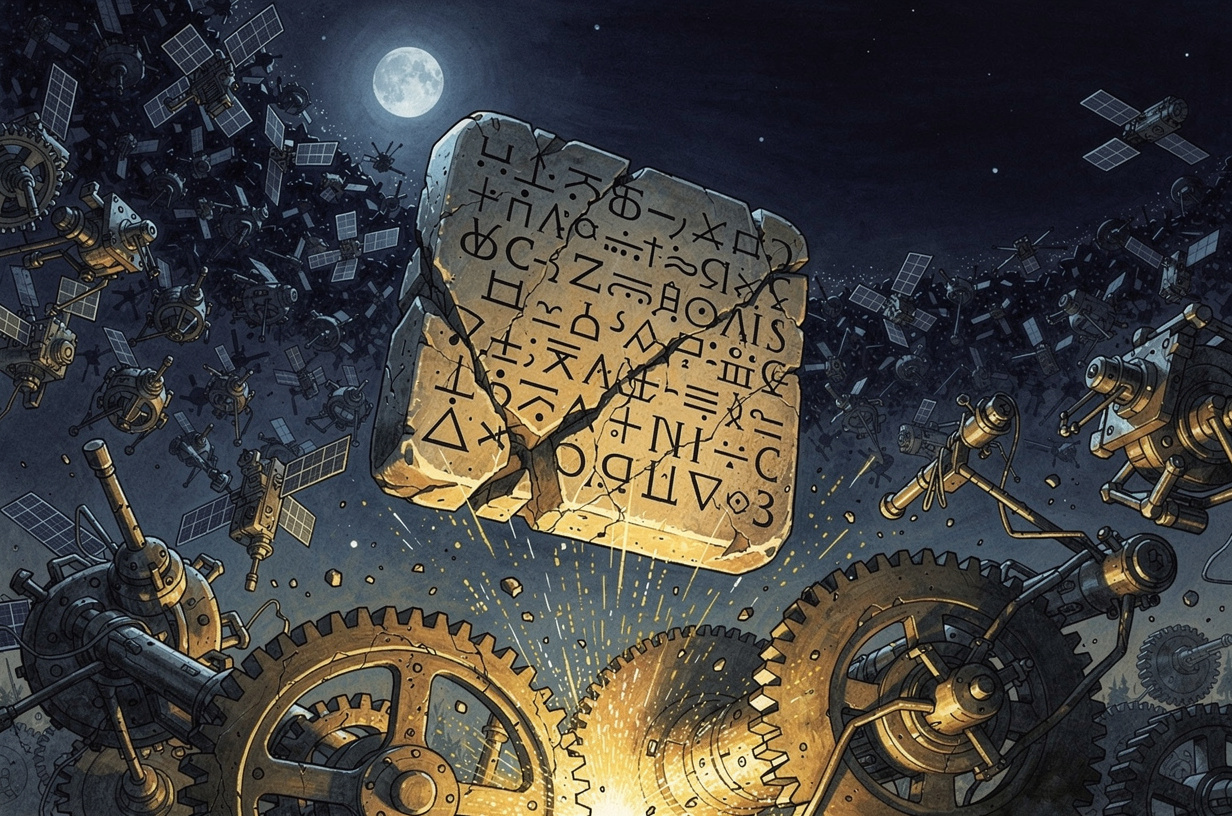
“a pattern of large AI companies using litigation to block talent from flowing to smaller competitors could eventually attract the same regulatory scrutiny”
How this was made Verified AI
Every Intellegix briefing is generated from that day's broadcast and run through automated checks before it publishes — with a human paged on any flag. Here is the trail for this edition.
Apple Takes OpenAI to Court — and Puts Silicon Valley's Talent Wars on Trial

Apple has sued OpenAI over alleged trade secret theft, accusing former employees of carrying proprietary information with them when they departed for the rival AI company. The lawsuit, reported by 9to5Mac, drew nearly six hundred comments on Hacker News — the most of any story on the day — and quickly became a referendum on the ethics and economics of talent mobility in the AI industry.
Because California renders non-compete agreements largely unenforceable, Apple's legal theory rests instead on trade secret law — specifically the federal Defend Trade Secrets Act and its California equivalent. To prevail, Apple must demonstrate both that the information in question was actively protected and derived economic value from secrecy, and that former employees misappropriated it through improper means. Legal observers in the Hacker News thread noted that the line between 'general expertise developed at Apple' and 'Apple's specific trade secret' is precisely where these cases become difficult to litigate.
Several commenters with apparent legal backgrounds suggested the lawsuit may function as much as a deterrent as a legal action — that even a loss on the merits could impose significant costs on OpenAI through the discovery process alone. Others pointed to a deeper irony: OpenAI's own founding team was built on the free movement of researchers between Google, academia, and other organizations, the same open circulation of talent that critics say Apple is now trying to curtail.
The case also carries a background hum of antitrust history. The Department of Justice previously investigated no-poach agreements between Apple, Google, and other tech giants, a case that settled in 2015 for four hundred fifteen million dollars. Legal scholars note that while the current litigation is civil trade-secret law rather than antitrust, a pattern of large AI companies using litigation to block talent from flowing to smaller competitors could eventually attract the same regulatory scrutiny. Apple's strategic exposure is real: the company has been notably quieter than competitors in the public AI race, and if it is losing key researchers to faster-moving rivals, no lawsuit can fully substitute for a compelling place to do frontier work.
GPT-5.6 Sol Ultra Claims a 50-Year Mathematical Prize — Experts Are Not Yet Convinced
A PDF uploaded to OpenAI's content delivery network purports to show that GPT-5.6 Sol Ultra has produced a proof of the Cycle Double Cover Conjecture, an open problem in graph theory dating to approximately 1978. The conjecture holds that for every bridgeless graph there exists a collection of cycles covering every edge exactly twice — simple to state, and resistant to proof for nearly half a century despite serious effort from accomplished combinatorialists. The document generated close to four hundred Hacker News comments, with credentialed mathematicians actively working through the argument.
Early reactions in the thread ranged from cautious optimism to pointed skepticism, and both responses reflect something real. AI-generated mathematical text can be syntactically well-formed — correct terminology, familiar proof structures, plausible-sounding logical steps — while containing subtle errors that only domain experts catch after sustained scrutiny. Formal verification tools such as Lean or Coq can mechanically check proofs, but only when the AI produces output in those constrained formal languages rather than readable prose. Until the document receives peer review from specialists in that corner of combinatorics, appropriate skepticism is warranted.
If the proof does hold up, it would carry implications beyond the specific result. Mathematical proof has long been treated as the domain where human reasoning is least replaceable — the creative leap, the sense for which approach might work, what the hosts described as the aesthetic instinct guiding mathematical discovery. A verified AI proof of a significant open problem would push that boundary in ways the field is not fully prepared to process.
Also trending on Hacker News was the 'AI 2040: Plan A' scenario-planning document, which drew two hundred ninety comments. The framing — 'Plan A' implying the existence of alternatives — reflects a community appetite for serious long-horizon thinking about multiple qualitatively different futures, not merely variations on a single trajectory. Separately, Xiaomi published detailed technical work on inference optimization for its MiMo v2.5 model, advancing what the company calls 'Hybrid SWA' efficiency — a Sliding Window Attention approach designed to reduce the quadratic computational cost of attention at longer sequence lengths. That work is notable partly because it comes from a hardware company with strong incentives to make models run efficiently on its own chips.
Good Tools, Hard Lessons: The Philosophy of Developer Tooling — and Seven Years of Haskell in Production

An essay titled 'Good Tools Are Invisible' attracted more than two hundred comments on Hacker News, resonating with a community that has grown visibly frustrated with the increasing complexity of modern development environments. The piece argues that the best tools vanish from conscious attention — they extend a programmer's capabilities without demanding that the programmer think about the tool itself. Much of the engagement centered on the widely shared sense that contemporary tooling has moved in the opposite direction, requiring deep familiarity with the tool as a prerequisite for using it on real problems.
That theme found a concrete, painful illustration in a post-mortem by Avi, founder of the developer analytics company Scarf, documenting seven years of running Haskell in production before reluctantly migrating away. The account is candid about why the language appealed — strong type guarantees, correctness at compile time, expressive power — and equally candid about the costs that accumulated over time. Hiring proved consistently difficult given the small pool of experienced Haskell engineers. Training new engineers took longer than with mainstream alternatives. And debugging production incidents involving lazy evaluation and memory usage could be genuinely hard, in ways that surprised even experienced practitioners.
The Hacker News comment thread split predictably between developers who recognized the experience and Haskell advocates who argued the problems were real but solvable for the right team. The more durable observation from several commenters was that language choice is fundamentally a hiring and organizational decision as much as a technical one — and a language with a structurally small talent pool imposes a constraint that does not disappear regardless of the language's intrinsic merits. The tension between the two pieces is instructive: Haskell is in some respects a powerful tool, but it is not an invisible one.
On the more accessible end of the spectrum, a Show HN project called Colibri earned eight hundred sixty points and over two hundred comments. Its creator, VuggJ on GitHub, built a system for running GLM 5.2 — the ChatGLM family of large language models from Tsinghua University — on slow, underpowered hardware. The project matters beyond its technical cleverness: if capable AI models run on commodity machines without cloud subscriptions or expensive GPUs, access to those capabilities broadens considerably. Also worth noting was pgrust, a Rust reimplementation of PostgreSQL that has passed one hundred percent of the original database's regression tests — a milestone that signals serious engineering fidelity to a codebase that took decades to harden.
SpaceX's 100,000-Satellite Ambition, RF Signals Through Walls, and the Case for Server-Free Smart Devices

SpaceX has filed with regulators to launch an additional one hundred thousand Starlink satellites on top of the roughly twelve thousand already approved and the several thousand already in orbit, with the stated aim of delivering one hundred times the current bandwidth capacity. The filing drew six hundred fifty-three comments on Hacker News — the bandwidth promise is real, and Starlink has already changed connectivity options in rural areas, maritime contexts, and disaster response scenarios where terrestrial infrastructure is absent or damaged.
The astronomical community in the thread was emphatic about the costs. Professional observatories have already developed mitigation strategies for the existing constellation, and astrophotographers at every level deal with satellite trails as a matter of routine. Scaling to a hundred thousand satellites does not merely worsen the existing problem proportionally; it potentially crosses thresholds where certain radio astronomy becomes significantly harder and the optical sky in low-light conditions is materially changed. The orbital mechanics concerns are equally serious: low Earth orbit is a finite shared resource, and the theoretical Kessler cascade — a self-sustaining chain of collision debris that renders an orbital shell unusable — is not an abstraction at the densities SpaceX is proposing. SpaceX argues that operating at low altitudes ensures natural deorbit within a few years, preventing long-term accumulation; whether that argument holds at ten times the current scale is actively debated among orbital mechanics researchers.
At a much more human scale, hardware writer Jeff Geerling posted about the QuadRF, a software-defined radio device he used to detect drones and visualize WiFi signals through walls. The piece earned two hundred one comments, and the reaction spanned genuine enthusiasm for the capability and unease about its implications. The hardware is consumer-accessible — the same device that lets a homeowner check for unauthorized drones can also map building occupancy from outside the structure or detect the presence of specific networked devices. The Hacker News discussion ran squarely through that tension.
A third hardware story offered a gentler vision of networked objects: a smart fan controlled via iroh, a peer-to-peer networking library that establishes direct device connections without routing traffic through a central server. A phone app connects directly to the fan — no manufacturer cloud, no subscription, no data transiting a third-party platform. The project is a proof of concept for the local-first computing philosophy that has significant traction in the Hacker News community, motivated by a recurring critique of current smart-home products: when a manufacturer shuts down its cloud service, the devices it sold stop working. Peer-to-peer control inverts that dependency, though establishing reliable connections across NATs and firewalls is exactly the unglamorous problem iroh is designed to solve.
Relativity in Chemical Bonds, a Lost Egyptian City, and the Lessons of Bronze Age Collapse

New research from Brown University is offering experimental confirmation that Einstein's theory of relativity directly shapes chemical bonding in heavy elements. In heavy atoms, inner electrons travel at speeds that are a significant fraction of the speed of light; the resulting relativistic increase in electron mass causes their orbitals to contract, which in turn alters how outer electrons interact and bond. The effect explains anomalies that have puzzled chemists for decades — gold's distinctive yellow color, mercury's liquid state at room temperature — and the research earned two hundred sixty-eight points on Hacker News alongside a comment thread running into the significance of physics and chemistry sharing an underlying reality that does not respect disciplinary boundaries.
Archaeologists using ground-penetrating radar and non-invasive survey techniques have mapped a previously unknown ancient city beneath Egypt's desert, including a church and other structures apparently dating to the Byzantine period — roughly the fourth through seventh centuries CE. The discovery drew one hundred thirty-four Hacker News comments, a substantial portion of which turned into a discussion of how satellite imagery, LiDAR, and subsurface radar have transformed the pace of archaeological discovery. The consensus in the thread was that more 'lost cities' will likely be found in the next two decades than in the previous century, simply because the detection tools have improved so dramatically.
A long-form essay on the Late Bronze Age Collapse — from the history blog A Collection of Unmitigated Pedantry — earned three hundred seventy-seven points and two hundred sixty-one comments, and its resonance with a technology community in 2026 was not hard to understand. Around 1200 BCE, the palace-based civilizations of the Eastern Mediterranean — Mycenaean Greece, Hittite Anatolia, the Egyptian New Kingdom — contracted dramatically or collapsed within roughly a generation, and the Bronze Age trading network that had connected them dissolved. The essay treats the collapse as a case study in how complex interdependent systems fail: the network's specialization, which made it productive, became a liability when multiple stressors struck simultaneously. Commenters drew explicit connections to contemporary supply-chain fragility.
That theme found a contemporary illustration in a Bloomberg report, also trending on Hacker News, on the United States' decade-long failure to build reliable domestic medical glove manufacturing capacity despite nearly a billion dollars in government support. The piece traces the fundamental difficulty of competing with Malaysian manufacturers who hold decades of accumulated process knowledge, trained workforces, and supplier relationships — expertise that cannot simply be purchased with an appropriation. New York City's new ban on deceptive subscription practices — dark patterns that make signing up easy and canceling nearly impossible — drew five hundred thirty-seven points, with the discussion centering on both the merits of the policy and the enforcement challenge of proving that a confusing cancellation flow was deliberately designed rather than merely poorly built. Because New York's regulatory weight often drives national compliance, the legislation may have reach beyond city limits.